Showing posts with label france. Show all posts

Tuesday, April 11, 2017

Benedictines and bubbly; the Abbey of Saint-Hilaire


From the village of Limoux, not far from Carcassonne, the road to Saint-Hilaire and its Benedictine abbey, winds through woods and vineyards. In October, the mists and autumn colours add to the sense of time-travel as stone walls loom out of nowhere. This probably means you are lost, as we were, and that you should have taken the much shorter road. But then you would not have seen the cemetery on the hill, blooming with chrysanthemums in preparation for Toussaint, All Saints' Day, a national holiday when the French pay their respects to their dead.

The houses of the village encroaching on the abbey
The dead were all around me as I walked alone in the cloisters, the only visitor to an abbey founded in the early 9th century, the place where the body of Saint Hilaire was buried. It was mentioned at this time in a charter from Louis le Debonnaire, confirming donations from his father Charlemagne to Abbot Monellus of St-Hilaire. Early features remain in the later buildings and over time, the village has crept from outside the abbey walls to lean over the church itself.

My spirit guide
If you love medieval history, as I do, you will find treasure here. One of the fascinating characters who has turned up in my 12th century research is the Master of Cabestany but I never expected to find one of his masterpieces in this little village in the Languedoc. Made of one slab of white marble from the Pyrenees, this 'sarcophagus' is more accurately an altar piece because it is far too narrow and could not contain a corpse.
The current setting of the sarcophagus,
which was probably once the main altar, in the choir
Look at the people, gawking out their windows as the martyred Saint Sernin is beaten and torn apart by a goaded bull. He still manages to bless the two women who pray for him. Medieval brutality and Christianity in all its horrific richness.

Medieval rubber-neckers
A jongleur on a  tight-rope is distracted by the goings-on
The goaded bull and animals representing the bestial nature of the saint's oppressors


The identity of the Master of Cabestany is a mystery but his - or could it be their? or even her? work is famous throughout Catalonia, known for a certain style. I find it strange that the story progresses from right to left and, having written about left-handers, I wonder whether this was an accidental left-handed reversal of European writing convention? Or deliberate left-handed choice? Or could the Master have been from another culture, where writing flowed from right to left? It seems more than odd for an artist of this quality not to be aware of conventions. Do let me know your theories!

The story of Saint Sernin, reading from right to left (missing the two side panels),
from his evangelical preaching to his gory end

Mysteries and ghosts were all around me and I jumped when something brushed my leg - a cat who accompanied me with the air of a guide who knew all and wasn't telling. Many monks must have met unnatural ends here and when you climb the pulpit in the monks' refectory, you hear your words of warning ringing out around the hall. The protection of the Counts of Carcassonne was not enough to keep the abbey safe in the madness of the Albigensian Crusade that swept Languedoc in the 13th century and the monks were accused of heresy and merged with Les Frères Prêcheurs, the Dominicans.

The Benedictines emerged from their troubles and endowments from the local nobles continued. Naturally the Abbot's apartment benefited from such generosity and I was feeling cynical as I walked into a room that took my breath away. The textures and patterns on the ceiling reminded me of those in the Palace of Joy in Zaragossa but the addition of satirical portraits make it look like an illuminated manuscript, with which a scribe has had fun in the margins.

Abbot's chamber ceiling, with portraits
Detail of ceiling portraits

Heraldic shields on the walls below the decorated ceiling

My favourite motif - a heraldic beast with banner in its teeth

Patterned rows carved in wood

The walls bear the shields and names of all the Abbots and you can imagine how excited I felt at seeing the dates 1146 and 1154. I get the shivers every time I come across details of the period I write about.
The Abbots of 1146 and 1154

Perhaps the Abbey's biggest contribution to the world came in the 16th century. In 1531 the monks created what is claimed here to be the first sparkling wine in the world, the 'blanquette' for which Limoux is now known and I stood in the very 'cave' or cellar where a monk was surprised by bubbles forming in the corked bottles of white wine, as if they were undergoing a second fermentation...

The birth-place of sparkling wine: the wine cave in St-Hilaire

From its origin in this cellar, bubbly gained international popularity, leading 17th century Irish dramatist George Farquahar to comment, 'Brut sparkles like the lively remarks of a man of wit.'

The famous 'blanquette'
Photo: Agne27 at the English language Wikipedia

As I turned to go, I sensed a lighter presence than the black monks. A faded inscription above a door lintel gave me enough of a clue to work out who used to come here and why. Can you figure it out?


A long discussion with the Abbey curator confirmed my guess - this became the 'Ecole Publique des Filles' in the 19th century so the girls and small boys from the village came here for their lessons. The curator also clarified much else about St-Hilaire and played troubadour CDs for me. Now all I need to know is whether Estela and Dragonetz passed this way, and, if so, why.


Friday, September 25, 2015

Part 2 Thank you, Rachel Koch, from those who speak with tails


Welcome back, Rachel. Last time you visited, you told the story of Max, a special dog. This time, we're going to talk more about dog fostering and adoption in general.


Rachel with her pack
How many Great Pyrenees live with you ? I have 7 Great Pyrenees at the moment: 3 males and 4 females.

How do you introduce a new dog to the pack?
I just walk with the new dog and the rest will follow.  I’ve never had any problems.  If it is a young Pyrenees with a lot of blabla I present them to the pack and normally the blabla disappears very quickly when they are confronted by 7 other Pyrenees. Behavioural problems like that normally solve themselves.
I remember you once said it was like a man walking into a bar full of really strong people - he doesn't put on a tough act in that situation.


The pack chez Rachel
Do you intervene in the relationships between the dogs?After a month or two, maybe three, the pack will find out themselves where the new dog will be in rank. I never intervene. A pack is a pack and I am not a dog, but I am the pack leader so all the dogs stand under me. That has to be clear from day one!

I know that you worked with huge packs of hunting dogs in England. How did that come about? What did you gain from the experience?
Through friends that I had met through hunting I came into contact with various large dog packs in England and France.

The old saying is 'look at dogs and you will learn'. People do not take the time to observe and they treat dogs like humans and that is where all the trouble is coming from. A dog has a different way of looking at things. I see so many mistakes that people make and dogs going into a shelter because it is allegedly a mean dog who has attacked children. But for a dog, a child can be seen as another dog. 

This is very important - if a child walks by with a sausage, the dog will take it because he thinks that the child is lower in rank than he is. The dog would never try to steal the same sausage from a higher-ranked dog. That is why you should not intervene in a pack and normally they will sort themselves out. A dog that is too late for dinner eats less than the rest etc. Of course it is a difference if you have one dog or 10 or 60 but  basically it is always the same. If you want a stable environment, whether you have one dog or many, you must be a pack leader otherwise the dog will take over!


Christmas chez Rachel
You have succeeded with all kinds of dogs, including those who have been labelled as dangerous, aggressive with people or with other dogs; what is the secret of your success?
Especially in the beginning with an aggressive dog (by the way not so many dogs are aggressive it is mostly through fear that they developed that behaviour) but the best thing to do in the first encounter with a dog not to look at him and not to touch him just avoid him and give the dog time to come to you. I also think that as a pack leader you need a certain energy that the dog will pick up; do not hesitate and again maybe only 2 or  3% of dogs are really dangerous and the rest is simply bad behavior that you can correct with time.

Feeding Time
How do you cope when dogs you’ve fostered, and loved, go to new homes?
You simply have to. Of course it is not always easy but as a foster home you cannot keep every dog  and I am always happy if they find good homes.

As somebody who offers foster care, you have to work with many organisations. Do you ever find it hard to stay on good terms? If you disagree with their advice? Or if you know that the conditions in which the dogs are kept are appalling?
It is sometimes not easy. Some organizations are happy that the dog is in a foster home and think that the problem is solved. You have to ask them again and again to find an adoptant. They always think that you will keep the dog but the problem is that if you want to continue to foster dogs you cannot keep them all.

Let’s talk about money. Sometimes thousands of euros can be spent getting one very ill dog transported hundreds of miles to be rescued, while another healthy abandoned dog in a SPA, near the rescuer, is put down. Do you think associations make rational business decisions?
No I think a lot of organization are not run as a business but are run by people who react from their heart and not with rational thinking. I also think that organizations put sad pictures on the internet to get the most amount of money to finance other things. I had that with a dog from Spain who was in a very bad situation for months and months I was called by two ladies who had already donated 1000 euros to get the dog to France. However the dog was still in Spain and there was always an excuse why the dog could not be transported but they kept putting the most horrible pictures on the internet demanding for money.

So I decided to contact with the organization and informed them that I would take care of transport with the money they already had from the two ladies and otherwise I would expose the story on several sites. I arranged transport and the dog was brought to me the following week me in an extremely bad condition. I am not certain if he had been kept for much longer in the shelter in Spain where he was being fed bread if he would have survived.

I sometimes feel that the money that is spent bringing a dog in from a far away country could be better spent closer to home. Am I against taking dogs from Spain?That depends if somebody falls in love on the internet and wants to pay transport etc. to adopt that dog. There is nothing wrong with it but I am against organizations that use that kind of pictures to gain money even if it is to finance other things because I had the good example of the two ladies who paid 1000 euro for one dog and the dog nearly died in Spain. In my opinion that is bad management!

As somebody who fosters dogs, you make loads of money, don’t you? And get lots of other support too?
I never received any money except for the transport of the Spanish dog paid by the two ladies and it took a while to convince the organization!  I always pay the vet and the food. I see that as my contribution to help.  So as a foster home I have never received any money.

How do you keep your spirits up while working with abandoned, abused and ill dogs in a world that seems ever worse for them?
I always think that one dog saved is one dog saved. As harsh as it may sound, I do what I can but you simply cannot save them all.


Twilight barking chez Rachel
Tell us about some of the dogs who’ve come to live with you. 
We kept several dogs mostly because they were already quite old or very difficult to place.  Cimba, who tried to climb up the walls out of fear when he first came to our house and Weasson who had been maltreated.  Unfortunately they all died several years after they came to us, from causes that began in their ill treatment. 

Weasson died from a brain tumor, probably caused by being hit on his nose by his previous owner. He developed a tumor above his nose). Cimba was mistreated with a stick in his mouth when they wanted to move him from one box to another in the refuge.  He died from cancer of the jaw probably from the injury.  Max died from lymphatic cancer and that was very difficult for me because he finally had a good home but had such  a short time to enjoy it.

So yes, it is a great joy to be a Foster Home and yes, it is also difficult to lose a dog who in your opinion would have deserved a better life for many years but that is life and it does not always go as you want to.

Thank you, Rachel. 

If you would like to win an ebook of my story 'Someone To Look Up To' just post a comment below, before 30th September, in any of the blog posts about Rachel. If you already have my story from the viewpoint of a Great Pyrenees, please choose another book.

Rachel is happy to answer any questions you might have so feel free to post them below.

amazon link


Thursday, June 18, 2015

Taking Stock as a Photographer

What do you really want to photograph?

To answer that question, I spent last weekend in a workshop with Ana Puig Rosado, an amazing photographer who lives only 30 minutes' drive from me in the beautiful lavender valley of La Roche St Secret. This is my photo of her house, reflected in the window of a typical Provencal cabanon. She maintains two websites to separate her photo-journalism from her weddings and other projects. Both are stunning.

Fears that my French would let me down diminished as I discovered that 'RAW' is 'RAW' in French, pronounced 'Roe', evidemment. Camera settings and menus are all in English so it's my French friends who have to get used to S for Vitesse (or for Canon shooters TV, which I always think of as Toute Vitesse).

Ana travels. Sometimes commissioned, sometimes with a project she hopes to sell afterwards and sometimes because she just 'wants to go to Tel Aviv.' She is a photo-reporter, working usually with natural light and an emphasis on getting it right in camera. She is the antidote to stock photography, in which I've been semi-conditioned for the last 6 years. Her notion of editing is to choose a small selection of photos that make a coherent collection.

Here's the portfolio that Ana put together showing the workshop behind the scenes as well as mini-galleries from each of us (mine is the first one).  

Until recently, I saw each photo as a one-off. Albums were 'best of'. Influenced by reading David DuChemin, I have started to think about collections as a whole, in the galleries on my website; in the selection chosen with my Editor for 'One Sixth of a Gill'. You can imagine how pleased I was with the reviews from the Wishing Shelf judges; 'A worthy finalist... 5 (of the 31) judges thought that the photography was the best part.' It is time to ask more of myself as a photographer.
If you'd like a free copy of 'One Sixth of a Gill' please sign up here for my newsletter.

With perfect timing, I received a professional report on the portfolio from LensCulture, whose portrait competition I'd entered. By happenstance, this is also the organisation which featured Dead Season on the Edge of the Black Sea by - guess who - Ana Puig Rosado! Some things are just meant to be.

The opportunity to receive a review was given as a bonus for entry and I was asked to submit a portfolio of 10 photos. I chose the 3 portraits I'd entered for the competition (that hadn't won) and 7 others I liked, showing the range of my work.


Don't cheat. look at these photos and decide what feedback you would give. Then read what I was told. 


Reviewer Feedback

I found some of these individual images very interesting and was drawn in by your innovative approach to self-portraiture. The mix of work here is very eclectic. I can understand it is hard to summarize your work in one edit and you may have wanted to demonstrate the depth and breadth of your practice, but I suppose we are just very used to seeing series of work in photography where you see one body of work explored in-depth. There are many images here that are very singular and beautifully taken shots particularly image 5 and 6. But I would encourage you to move from picking an individual good image to thinking about your work as a series.

Editing into a coherent series would enable the viewer to see more of you and how you work and also what you have to say. As we are so saturated by images all the time we need to work out what we are looking at and how to position it easily. I notice you do not have an artist's statement. It might be a very helpful exercise for you to write one. I realise they are hard to do as they in part require you to be concise and clear about what you are doing and you may work in a more organic less premeditated way. But the advantage is they force you to consider what might connect your work, and help you to develop confidence in your own voice.

Perhaps that is why the self-portraits interest me, they tell me more about you ( I am assuming they are of you). They make me think of Bill Viola's moving and slow studies of faces which take on a religious or spiritual edge and are very powerful. I like the idea that a single fixed image of self is never enough. We change so much over time and expressions alter our faces completely and you capture this well with this group of 3 images. I hope you will continue with those more in the future.

What do I think of the review?

I'm chuffed! And I smile now at my naivete in putting the collection together in such a random way. I'm writing this blog for everybody who's shared in my progress as a photographer - and for others who still think of one photo at a time.

Compliments like those in the review are really motivating me to carry on experimenting without worrying about what will sell in my istockphoto portfolio

Thank you to that anonymous reviewer, who made further suggestions. I would love comments from other photographers on the blog, on the review, on the idea of collections. I haven't answered the question of what I really want to photograph but I have some ideas!

Thursday, January 22, 2015

The Princess' 9th Birthday Celebration

9 years ago today, a puppy was born on a farm in the Pyrenees. 


For some reason, her choosing fell through. She was still playing with her siblings when someone on her breeder’s waiting list phoned for news of the next litter and said ‘We’ll take her.’ 
Jean and Blanche's family at the Neouvielle kennels
The masters-to-be drove for 5 hours to fetch her and 5 hours home. Then they suffered hours of Béarnaise folk songs howled until no-one could bear any more and a compromise on sleeping-place was negotiated (the puppy chose her place and the people got some sleep). And so Blanche-Neige de Néouvielle arrived like an avalanche into our lives.  

You always think that having had dogs prepares you for the next one. It doesn’t. If you’re lucky enough to have known the friendship of an old dog, you are doubly unprepared for the next puppy, lulled into a false sense of expertise. It’s like childbirth; if anyone remembered what it was really like, no-one would do it twice. And with giant dogs, everything is bigger.

Blanche is the only dog I’ve known who didn’t just devour books; she chose them by sniffing along the bookshelves. She had a penchant for Terry Pratchett but if she could sniff out a book one of us was currently reading, and chew the last pages up on the lawn before we finished it, she was in ecstasy. Just when we’d established some basic principles of living together, we collected her friend, Bételgeuse de la Plaine d'Astrée. And that’s when the fun really began. You’ll note that the humans look much younger in the early photos.

Out-take1
Out-take2

Official Photo - John with the puppies 2006
Before allowing us to take her puppy away, Blanche’s breeder, Nadine, asked us, ‘What sort of life are you offering her?’ I’ve written about Nadine and her Pyreneans, in The Dog who cries Wolf (One Sixth of a Gill) and she can be fierce on her dogs’ behalf.

I can answer Nadine now; this is the life Blanche has offered us, for 9 crazy years.

We prepared for our puppy.

Daiquiri preparing to train her 4th and 5th Pyrenean Mountain Dogs
The puppy had things to learn too.

So that's a cat!
Like most aristocratic demoiselles, Blanche went to finishing school in Switzerland. Here she says thank you to top dog trainer Michel Hasbrouck, at the end of 2 days of Dressage Tendresse (I translated his bestseller into English as Gentle Dog Training)
Blanche and Michel
The only time I've ever dressed up a dog was when Arsenal reached the Champions' League Final and I became over-excited.
Thierry Blanche Henry
The dynamic duo grew up together... and grew... up. 

... finishing at 50kg and 70kg. Weighing a 6 month old male Pyrenean is fun.           

The games Bétel invented with Blanche lived on after we lost him to health problems and visitors can still enjoy being ambushed by white lightning. She hides behind the hedge then surprise-bombs them.

In her middle years Blanche perfected her modelling skills for my istock portfolio and can be found on many leaflets and websites, the face of pet care and dog training, both on her own and with her friend Lou.


When I told John my idea for this shoot, his get-out clause was 'You'll never get the dog to do it.' Blanche gave an Oscar-winning performance and I love this family portrait. She was actually obeying a long down-stay but the expression shows total immersion in the role. This photo features in a French article about homeless people and their dogs 


Blanche has welcomed two shelter dogs into her life, always confident in her relationship with us. We've holidayed together and we've grieved together. A year ago she had a stomach torsion, an emergency which is usually fatal. The operation was successful, despite her trashing her stitches and her cage the next day at the vet's, and refusing to eat until I was summoned to take charge. 


Blanche and Sherlock on holiday, Lac Ste Croix
She has a BIG character and an even bigger sense of fun.She inspired the character of Snow in Someone to Look Up To and committed some of the funny crimes attributed to Sirius. On one occasion, Bétel barked in the middle of the night to alert me; I threw on my dressing-gown, expecting burglars, and I found the door to the spare bedroom ajar. Blanche was curled up on the sofa in there, tucking into a box of dog treats she'd filched from the wardrobe. She still tests me out and she's still happy when I win. Dogs!

Her latest modelling credits include the book trailer for One Sixth of a Gill which also includes some of her photos; and a cameo role in the trailer for Someone to Look Up To, acting Sirius' brother. If Belle in the famous film can be played by a male, I don't see why my star actress can't change gender if required.


She is even going to be a pin-up girl. The 1st edition of the new International Magazine for Pyrs will be printed in March - with Blanche and Bétel featuring on the cover. You can see Blanche. The beautiful male featured on the left is called Romeo.

The magazine will also feature Someone to Look Up To in serial form. Check it out!

Subscribe to Pyr International Magazine


Happy 9th birthday, princess.


Among amazon.uk top dog books since 2013. 
'A wonderful dog story'

Amazon link


Tuesday, July 22, 2014

Sherlock - another dumped dog

By popular request, the story of Sherlock. His ears already have a fan club so it's time I let you meet him properly.

We wanted to motivate Blanche's recovery from her operation (stomach torsion) so we decided in February to get her a new friend. I had promised Lou that his successor (not replacement) would be, like him, a sweet-natured shelter dog that no-one else would want but who could cope with the somewhat brutal friendship of a Great Pyrenees. Hunting dogs are not popular for adoption because hunters assume they were useless at hunting and their background gives them the reputation of being unsuitable as family dogs and liable to run away. So we chose Rudy, who'd been found wandering the countryside in August 2013, with no ID. He was probably thrown out before the new season.

Rudy's prison mug-shot
Here in France, some hunting-dogs are loved all the year round, all their lives. Many, however, live in packs, in cages, exercised only during the hunting season and with no experience of homes and families. We were told that Rudy hadn't known what a caress was but was starting to enjoy them. That he was quiet but showed enthusiasm for outings, in his own way. We already knew what 'outings' meant from our adoption of Lou: a five-minute toilet break on waste ground, 3 to 4 times a week. The surprise with Rudy was that he didn't pull on the lead but he'd been trained (unintentionally) not to come when called. He'd be let off the lead for his five minutes, called, grabbed and taken back to the cage. Obviously, he preferred not to come when called. So we filled in the paperwork and changed his name to Sherlock.

When I went to his cage to spring him from the hellhole, he didn't even get up he was so depressed, and he barked just once, a big hound bay, fit for a Baskerville. I swear he knew I'd come for him and he didn't think he could go on much longer if I hadn't. The breed was new to me and I didn't realise till I got him home that the muscles of his hind-quarters were wasted from lack of exercise and he was far too thin. I thought back to the dish in his cage, piled high with pizza (restaurant left-overs) and untouched. The first night, he cried from the pain in his ears - yes, once again, and worse than with Lou, another floppy-eared dog with the most horrific, untreated ear infection. Dogs are so stoical and they put up with ear infections during the day when there are distractions but they can't sleep at night and the pain drives them crazy.

The vet fell in love with Sherlock and her good work, combined with a healthy diet and daily exercise, has restored his health. His bum is double the size it was and, in his case, that's great news. He's gained 5kg - a big percentage of his 35kg. Thanks to a Blog reader who emailed me, I had a new treatment to try for long-term ear maintenance and we seem to be managing the ear problems by using Zymox regularly (products you can order from the USA and that work miracles).

Sherlock at home
I'm sure from his behaviour that Sherlock had never been in a house before and the stairs up to the front door were a giant step for dogkind. It took a couple of tries the first time but he followed us and the big blonde into the house and into the living-room. He even fell asleep for a while until the T.V. was switched on and then he was completely panic-stricken, ran outside and wouldn't come back in. We left the T.V. off. It took a couple of days with gentle sound and his strong desire to be with us as motivation, and then he was watching Premier League football with everyone else. He still fled from Metallica videos for a while but, now, his favourite place to sleep is right in front of the television.

This is my third dog adoption, I have read hundreds of first-hand accounts from other people, and I have a theory about what I've experienced with all three, very different dogs. They have all been traumatised for the first few weeks and as the effects have worn off, their underlying personalities and experiences have started to show, in some unexpected ways. Sherlock was so numb that anyone could do anything with him for weeks; when he showed dislike and even fear of strangers, I think this was a sign that life mattered to him again and that he wasn't just accepting whatever happened. I know that I have not encouraged his fears in any way (my training is good enough to know that) and yet he is now nervous about situations he didn't care about at first.

Sometimes, trainers make the mistake of assuming that the adoptant is creating fears in the dog. Often, the debutante dog-owner does create fears in the dog! Reassuring and stroking a scared dog is classic reinforcement behaviour. But what I'm suggesting is that awakening from trauma can bring with it all those fears a dog has, based on past experience - or ignorance - and show its own personality, regardless of whether the owner does everything 'right'. Sherlock got over how scary the T.V. was and he has the intelligence and trust in us to learn confidence in other situations he hasn't met before - we are working on it.

We discover new things about him all the time. Training with treats hasn't been possible until now. I thought he'd probably been trained not to take treats and yet he would take little bits of chicken or soft cheese from my hand, and he will eat soaked dog kibble but not dry biscuits. Yesterday, I looked properly at his teeth, which the vet had declared to be good. They do look good when his mouth is closed, but the four middle bottom teeth are eroded, filed away? damaged? ground down on cage bars? I shall ask my vet next time I see her. But I'm now sure that he can't eat hard treats - not won't - and he's been happily accepting little soft cheese cubes today. I know there are other ways of training but I think this is going to help with communication. There are four of us in this marriage :)

After two months with Sherlock, we felt confident enough to take him on holiday for a week and I am very proud of how he behaved: he has been perfectly house-trained (despite never being in a house!) not destructive in any way and he copes with the princess. They are unquestionably one pack although he is not willing to play with her - yet. You will laugh at his one irritating habit. He is a bit of a whiner, especially if we leave the room and he wants us there. Especially first thing in the morning, at first light. Yes, I now have a dog who insists on giving 'A Song at Dawn' outside my bedroom window!!

John, Sherlock and Blanche, the princess, on holiday in Provence


Friday, May 9, 2014

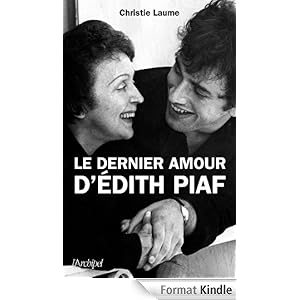
The Last Love of Edith Piaf - Interview with Christie Laume

You read it here first! I'm excited at bringing you a sneak preview of an amazing true story due out with Archipel Press later in 2014 and to welcome the author Christie Laume to my blog. This is the first time I've 'met' Christie but I feel I know her already because Jean-Daniel Belfond of Archipel asked me to translate her book 'Le dernier amour d'Edith Piaf' into English...

amazon.fr link
It was a dilemma for me. I've written 20,000 words of the third novel in the Troubadours series and it's going well so it's painful to break off with 80,000 words still to go. On the other hand, some opportunities don't come twice - or when it's most convenient - and I'm not one to say no to an adventure. To help me decide, I read the book. After that, I had to say yes . Who can resist the intimate detail, told for the first time, of a 46 year old French superstar's love - and marriage - with a beautiful man twenty years younger? This mature woman was hooked.

So I hope my readers waiting for the further adventures of Dragonetz and Estela will forgive the extra wait and consider my foster-book The Last Love of Edith Piaf, instead. When I read the book, I was struck not just by the love of the central couple but also the love of the author for her brother, the young man who was Edith Piaf's last love. I've translated a third of the book now and it's the perfect time to ask the author some of the questions that have come to mind, while I've been reading in French and writing in English.

About the author
Chryssanthi Lamboukas was born in Paris in 1942. When she was twenty, she was invited by her brother Théo and Edith Piaf to live with them and experience ‘the lifestyle of a star’, even though she herself was an unknown.  Prompted by motherly affection, Piaf wanted to launch the young woman as a singer and thought up her pseudonym, Christie Laume, under which name she made a number of records during the 1960s. She has lived in the United States since 1970.

Christie's first language is French but she has answered my questions in English, her second language. She also speaks Greek, which was the home language of her family. Her parents emigrated to Paris to escape war in their homeland but they never forgot their roots. 


Christie Laume photo by Eric Fougere
Bonjour, Christie. Your book is the true story of the love affair between Edith Piaf and a beautiful, talented man twenty years her junior – your brother Theo Sarapo. What made you decide to tell their story?

Many people ask me questions and they tell me because I lived with the couple, it would be good for me to tell the truth.  Also, I knew it was something I had to do in my life.

You show in the book how Theo was changed by his military service in the Algerian war and how your whole family lived in fear of losing him. What are your thoughts now, looking back on that time?

Theo changed in his military service during the Algerian war . Theo saw horrible things during that time and life had a different meaning for him .  When he finally could talk about it, I felt he wanted to live his life to the full, the way he wanted and not the way my parents saw it.

My parents loved their children so much and they knew Theo was in a terrible danger. It was a nightmare for them,  I understand them, I am a mother and a grandmother

On the surface, Edith and Theo seem mismatched; she’s a 46 year old superstar and he’s a 26 year old hairdresser when they meet. You lived with the couple so you knew them both well. How would you describe the relationship?

Edith was 46 and Theo 26, it was a big difference in age. They loved each other very much, they completed each other.  There love was above their age and above their physical appearance.  There love was so strong that they lived in their own world.

 How did people at the time react to them as a couple?

People had different reactions to them as a couple, some good, some bad. But after they saw how much they loved each other and how Edith was happy with Theo, people changed their minds.

When you describe your parents’ disapproval of the marriage, I was caught up in the realism with which you write. These are real parents, worried for their son’s future. Do you think they would have felt the same if the genders had been reversed?

At the beginning my parents had the same thoughts as other people about the age difference. Yes, they worried for my brother's future. If the genders had been reversed they probably would have accepted it better.

I love the way you show ‘behind the scenes’ and reveal so many realistic details of Piaf’s life, from eating habits to preparation for a concert. Where did you get all this inside information?

I had all this inside information by living with them in the same big apartment in Boulevard Lannes and also being with them during their concert tours.
  
Photo of young Christie Laume by Gerard Neuvecelle 


I get the impression that Edith had a profound impact on your life. In what ways did she influence you? 

Edith had a profound impact on my life at that time, she influenced me in many ways.  I was young and naïve.  I was raised in a very traditional  way.  I admired her great talent like every one.  But she knew my personality and she was very kind to me.

You had a career of your own as a singer. Did Edith give you any tips about singing?

Yes Edith helped me very much.  She told me how to be on stage, how to sing and how to pronounce each word. She took time to instruct me.

Do you think the USA, the UK and France have different attitudes to singers? It seems to me that French culture values the ‘chanson’ and its ‘interprete’ more than songwriting and the lyricist. I think it is more common in the UK and the USA to be a singer/songwriter and we don’t refer to a singer as an interpreter. What do you think?

I think the French have their personal ways to interpret  La Chanson. With their different ways of interpretation,  France, UK, and USA all have very talented people.

Edith herself did write some of her own songs but it’s not clear to me which ones. 

Edith wrote some songs.  Among these songs are  La Vie en Rose,  C'est l' Amour... But Michel Emer wrote  A Quoi ca Sert l'Amour .

What better way to finish the interview than by reading the extract from Christie's book that tells how this famous love song was born and by watching the two of them together performing their signature song.

PRE-PUBLICATION Extract from The Last Love of Edith Piaf 


When the spectacle at Olympia was in full swing and playing to a full house every evening, I found myself one afternoon at Boulevard Lannes in the company of Edith, Théo and Loulou Barrier. Michel Emer arrived. Michel was a well-known singer-songwriter, in Edith’s circle since before the war and already the composer of many of her songs. He seemed carried away with enthusiasm. He went straight to the piano and sat down, saying, ‘I have a song for you!’
He meant, ‘For Edith and Théo.’ He was already putting a sheet of paper on the music-stand. His fingers ran across the keyboard. He began to sing.
We listened to the whole song. It was absolutely perfect – at least in my opinion, even if I kept that to myself for the time being. Michel was right; the song told the truth about their life together. I could see that Théo and Edith were also excited. Loulou Barrier too.
Edith said straight away, ‘Stay at the piano, Michel. We’ll give it a whirl right now.’
Without further ado, they began to sing:-

A quoi ça sert l’amour?
On raconte toujours
Des histoires insensées
A quoi ça sert d’aimer?

What is the point of love?
We hear so much these days
Of mad and stupid ways
What is the point of love?

It was truly a wonderful song, which would soon be on everyone’s lips and on all our radios. The most extraordinary thing for me was to see its birth, in the emotion of an unexpected discovery. After a few attempts, Edith was so happy that she said, ‘We’ll put it into our repertoire.’
That was the beginning of a famous number that was to be repeated until the end of the season at Olympia. Edith would stop in the middle of her repertoire and wait for silence. Then she would turn sweetly to the wings and call, ‘Théo.’

Théo would reappear, moved, elegant, happy. He would come close to her and they would sing as a duo, ‘A quoi ca sert l’amour?’ Edith and Théo would be forced to give encore after encore. The fashion for duos was launched in Paris!

Copyright Archipel/ Christie Laume/ Jean Gill 2014

See Edith and Theo perform 'their' song

Thank you, Christie,  for being my guest and I hope you’ll come back to my blog for a virtual celebration when the book comes out later this year.


COMING SOON IN ENGLISH!

Théo Sarapo’s sister tells his story…


At the age of 26, Théophanis Lamboukas meets Edith Piaf, in January 1962. He is to become her second husband and the duo will perform her last big hit, ‘A quoi ça sert l’amour?’

When the star’s secretary, Claude Figus, introduces them to each other, Théo is so dazzled by ‘the Little Sparrow’ that he is speechless with emotion.  Smitten, Edith confides to Figus, ‘I want to see your friend again so I can find out whether he’s as smart as he is good-looking, because he hasn’t said a word all evening.’

They are driven to see each other again and Piaf encourages Théo to take up a career as a singer. She invents his stage name, Sarapo (‘I love you’ in Greek). They form a couple in life and on the stage, until Piaf’s death on the 10th October, 1963. Théo, her last love, joins her seven years later, victim of a car accident.

Their wonderful and tragic story is evoked here by Christie Laume; the singer’s last months as they’ve never been revealed before.