Showing posts with label true story. Show all posts

Friday, September 25, 2015

Part 2 Thank you, Rachel Koch, from those who speak with tails


Welcome back, Rachel. Last time you visited, you told the story of Max, a special dog. This time, we're going to talk more about dog fostering and adoption in general.


Rachel with her pack
How many Great Pyrenees live with you ? I have 7 Great Pyrenees at the moment: 3 males and 4 females.

How do you introduce a new dog to the pack?
I just walk with the new dog and the rest will follow.  I’ve never had any problems.  If it is a young Pyrenees with a lot of blabla I present them to the pack and normally the blabla disappears very quickly when they are confronted by 7 other Pyrenees. Behavioural problems like that normally solve themselves.
I remember you once said it was like a man walking into a bar full of really strong people - he doesn't put on a tough act in that situation.


The pack chez Rachel
Do you intervene in the relationships between the dogs?After a month or two, maybe three, the pack will find out themselves where the new dog will be in rank. I never intervene. A pack is a pack and I am not a dog, but I am the pack leader so all the dogs stand under me. That has to be clear from day one!

I know that you worked with huge packs of hunting dogs in England. How did that come about? What did you gain from the experience?
Through friends that I had met through hunting I came into contact with various large dog packs in England and France.

The old saying is 'look at dogs and you will learn'. People do not take the time to observe and they treat dogs like humans and that is where all the trouble is coming from. A dog has a different way of looking at things. I see so many mistakes that people make and dogs going into a shelter because it is allegedly a mean dog who has attacked children. But for a dog, a child can be seen as another dog. 

This is very important - if a child walks by with a sausage, the dog will take it because he thinks that the child is lower in rank than he is. The dog would never try to steal the same sausage from a higher-ranked dog. That is why you should not intervene in a pack and normally they will sort themselves out. A dog that is too late for dinner eats less than the rest etc. Of course it is a difference if you have one dog or 10 or 60 but  basically it is always the same. If you want a stable environment, whether you have one dog or many, you must be a pack leader otherwise the dog will take over!


Christmas chez Rachel
You have succeeded with all kinds of dogs, including those who have been labelled as dangerous, aggressive with people or with other dogs; what is the secret of your success?
Especially in the beginning with an aggressive dog (by the way not so many dogs are aggressive it is mostly through fear that they developed that behaviour) but the best thing to do in the first encounter with a dog not to look at him and not to touch him just avoid him and give the dog time to come to you. I also think that as a pack leader you need a certain energy that the dog will pick up; do not hesitate and again maybe only 2 or  3% of dogs are really dangerous and the rest is simply bad behavior that you can correct with time.

Feeding Time
How do you cope when dogs you’ve fostered, and loved, go to new homes?
You simply have to. Of course it is not always easy but as a foster home you cannot keep every dog  and I am always happy if they find good homes.

As somebody who offers foster care, you have to work with many organisations. Do you ever find it hard to stay on good terms? If you disagree with their advice? Or if you know that the conditions in which the dogs are kept are appalling?
It is sometimes not easy. Some organizations are happy that the dog is in a foster home and think that the problem is solved. You have to ask them again and again to find an adoptant. They always think that you will keep the dog but the problem is that if you want to continue to foster dogs you cannot keep them all.

Let’s talk about money. Sometimes thousands of euros can be spent getting one very ill dog transported hundreds of miles to be rescued, while another healthy abandoned dog in a SPA, near the rescuer, is put down. Do you think associations make rational business decisions?
No I think a lot of organization are not run as a business but are run by people who react from their heart and not with rational thinking. I also think that organizations put sad pictures on the internet to get the most amount of money to finance other things. I had that with a dog from Spain who was in a very bad situation for months and months I was called by two ladies who had already donated 1000 euros to get the dog to France. However the dog was still in Spain and there was always an excuse why the dog could not be transported but they kept putting the most horrible pictures on the internet demanding for money.

So I decided to contact with the organization and informed them that I would take care of transport with the money they already had from the two ladies and otherwise I would expose the story on several sites. I arranged transport and the dog was brought to me the following week me in an extremely bad condition. I am not certain if he had been kept for much longer in the shelter in Spain where he was being fed bread if he would have survived.

I sometimes feel that the money that is spent bringing a dog in from a far away country could be better spent closer to home. Am I against taking dogs from Spain?That depends if somebody falls in love on the internet and wants to pay transport etc. to adopt that dog. There is nothing wrong with it but I am against organizations that use that kind of pictures to gain money even if it is to finance other things because I had the good example of the two ladies who paid 1000 euro for one dog and the dog nearly died in Spain. In my opinion that is bad management!

As somebody who fosters dogs, you make loads of money, don’t you? And get lots of other support too?
I never received any money except for the transport of the Spanish dog paid by the two ladies and it took a while to convince the organization!  I always pay the vet and the food. I see that as my contribution to help.  So as a foster home I have never received any money.

How do you keep your spirits up while working with abandoned, abused and ill dogs in a world that seems ever worse for them?
I always think that one dog saved is one dog saved. As harsh as it may sound, I do what I can but you simply cannot save them all.


Twilight barking chez Rachel
Tell us about some of the dogs who’ve come to live with you. 
We kept several dogs mostly because they were already quite old or very difficult to place.  Cimba, who tried to climb up the walls out of fear when he first came to our house and Weasson who had been maltreated.  Unfortunately they all died several years after they came to us, from causes that began in their ill treatment. 

Weasson died from a brain tumor, probably caused by being hit on his nose by his previous owner. He developed a tumor above his nose). Cimba was mistreated with a stick in his mouth when they wanted to move him from one box to another in the refuge.  He died from cancer of the jaw probably from the injury.  Max died from lymphatic cancer and that was very difficult for me because he finally had a good home but had such  a short time to enjoy it.

So yes, it is a great joy to be a Foster Home and yes, it is also difficult to lose a dog who in your opinion would have deserved a better life for many years but that is life and it does not always go as you want to.

Thank you, Rachel. 

If you would like to win an ebook of my story 'Someone To Look Up To' just post a comment below, before 30th September, in any of the blog posts about Rachel. If you already have my story from the viewpoint of a Great Pyrenees, please choose another book.

Rachel is happy to answer any questions you might have so feel free to post them below.

amazon link


Thursday, October 9, 2014

Don't call me Shirley


I suppose it was inevitable that within minutes of us renaming our adopted dog 'Sherlock', my husband (a big 'Airplane' fan) said, 'Of course, we'll call him Shirley.' Sherlock/ Sherl/ Sherley/ G'boy seems very happy with his new names and life. He has a tail like a cat's and it's usually waving that little white hook at the end high in the air. His hind-quarters have completely regained muscle tone and a bum doubled in size suits him better than it does me; ditto the extra 5kg he gained gradually after he came to us. Read Part 1 of Sherlock's story

A Happy Tale


Sherlock is a griffon bleu de Gascogne, a Gascony Griffon, bred for hunting, abandoned with no ID. My suspicions that he was thrown out by his hunter-owner have been backed up by his behaviour. When we opened a bottle of Clairette (the local sparkling wine), the cork popping sent Sherlock into nervous running round. Purely in the interests of dog-training, we made sure he heard the sound frequently and he has grown used to it over the last eight months but this is not a dog who will cope with gunshots. He's scared when the hunters go past in their SUVs, hounds barking and trailers clattering. Nose glued to the ground as always and ears trailing, he didn't even see the pheasant that pottered into the woods on one of our forest walks. I suspect that he has the nose but not the temperament; or that a hunting accident traumatised him.

I do know that he was treated badly. He no longer flinches when I stroke him unexpectedly and he's no longer afraid if I'm cross (usually with Blanche and he worries on her behalf). He knows there's no hitting here and his confidence grows all the time. Yesterday was a big day; he looked me in the eyes and, for the first time, licked my nose. He seeks caresses now without fearing reprisals. In fact, he'll push Blanche aside to get his share and she's so sure of herself (and of me) that she doesn't mind. It wasn't safe for him to show his feelings and he is a reserved dog, who is taking the risk of expressing himself more and more. 

He is also deeply stubborn. He might have been beaten but he wasn't broken. I see it when Blanche plays dominance games. She is so much bigger that he can't avoid being jumped on but he doesn't buckle and he doesn't give in. He endures it. I suspect his previous training involved commands, stubborn refusal and then him being hit. The shelter reinforced recall as a bad thing (back into the cage if you came when called). That has changed completely with positive training but he still wavers sometimes at the final moment in recall. There's a lot of harm to unlearn. And he has no idea what play means. So motivation has to be praise, cuddles, need to be with me or occasional cheese cubes.

Sherlock sleuthing

I get funny looks when Sherlock is with me. One man waiting with me at the vet's told me he used to have a bleu de Gascogne. The dog got nicknamed 'Inox' the French name for a metallic pan-scraper, because the wire-haired coat is so harsh. The breed website shows a photo of owners; rows of men with guns and Sherlock-dogs.

Everyone knows that it is a bad idea to adopt a hunting dog. Why, I wondered, having adopted a hunting dog. A French friend told me, 'They escape. They run away all the time.' This was not good news. Escaping dogs die. The very next day, I found Sherlock outside the garden fence, running around the terrain that is open to a busy road. A lump in my throat, I called him back in. Blanche hadn't followed him - that time. John and I checked the fence, argued, blocked the hole that hadn't been there before, feared the worst. 

It happened again. I watched where Sherlock went when he was back on the inside, found the new hole. Heavy-hearted, I told John. It was a bad day. We both know from bitter experience what a determined escaper can be like and how dangerous it is. Gritting his teeth, John looked at the fence again. And then looked around inside the big garden. And saw what Sherlock had been trying to tell us all along, looking through the fence, pointing gun-dog style. Wild boar excrement. The holes had been made by wild boar coming down from the woods into the garden. All Sherlock had done was go through the hole and check out his outer territory - and then come home.

When strimming the grass outside the fence, someone had cut through the tension wire at the bottom and that was all it took to allow piggy diggings and a break-in. Acorns and worms in damp soil all attract the boar. Luckily a strand of barbed wire along the bottom of the fence outside stopped the nocturnal invasions - big thanks to the Welsh friend who gave me that tip.

Sherlock has made NO escape attempts so another myth can be exploded; hunting dogs don't all want to run away.

Sherlock on his holidays by Lac St Croix

Apart from the nose-lick, yesterday was a big day for another reason; vaccinations and health check. It's good news. The way I'm treating Sherlock's ears is working so although they are dirty and need wiped regularly, the regime of a week's Zymox, then a break, has prevented any return of infection and can be carried on forever. No talk of operations, nor even of antibiotics. One healthy, shiny, happy dog.  My vet has remained impassive in the past while I've sobbed all over her consulting-room but this time she cracked completely, in a good way. Yesterday, she stroked Sherlock and we agreed that he wasn't the sort of dog who'd attract potential owners but that he was beautiful, 'well-proportioned'. She told me, 'I love this dog. There is something peaceful about him.' The word she used was 'reposant', which carries the sense of 'makes me feel peaceful.' Yes, 'reposant' is a good word.


Friday, May 9, 2014

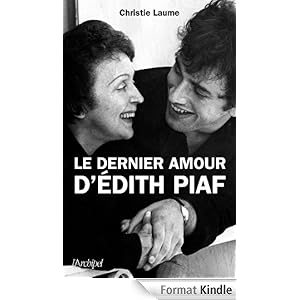
The Last Love of Edith Piaf - Interview with Christie Laume

You read it here first! I'm excited at bringing you a sneak preview of an amazing true story due out with Archipel Press later in 2014 and to welcome the author Christie Laume to my blog. This is the first time I've 'met' Christie but I feel I know her already because Jean-Daniel Belfond of Archipel asked me to translate her book 'Le dernier amour d'Edith Piaf' into English...

amazon.fr link
It was a dilemma for me. I've written 20,000 words of the third novel in the Troubadours series and it's going well so it's painful to break off with 80,000 words still to go. On the other hand, some opportunities don't come twice - or when it's most convenient - and I'm not one to say no to an adventure. To help me decide, I read the book. After that, I had to say yes . Who can resist the intimate detail, told for the first time, of a 46 year old French superstar's love - and marriage - with a beautiful man twenty years younger? This mature woman was hooked.

So I hope my readers waiting for the further adventures of Dragonetz and Estela will forgive the extra wait and consider my foster-book The Last Love of Edith Piaf, instead. When I read the book, I was struck not just by the love of the central couple but also the love of the author for her brother, the young man who was Edith Piaf's last love. I've translated a third of the book now and it's the perfect time to ask the author some of the questions that have come to mind, while I've been reading in French and writing in English.

About the author
Chryssanthi Lamboukas was born in Paris in 1942. When she was twenty, she was invited by her brother Théo and Edith Piaf to live with them and experience ‘the lifestyle of a star’, even though she herself was an unknown.  Prompted by motherly affection, Piaf wanted to launch the young woman as a singer and thought up her pseudonym, Christie Laume, under which name she made a number of records during the 1960s. She has lived in the United States since 1970.

Christie's first language is French but she has answered my questions in English, her second language. She also speaks Greek, which was the home language of her family. Her parents emigrated to Paris to escape war in their homeland but they never forgot their roots. 


Christie Laume photo by Eric Fougere
Bonjour, Christie. Your book is the true story of the love affair between Edith Piaf and a beautiful, talented man twenty years her junior – your brother Theo Sarapo. What made you decide to tell their story?

Many people ask me questions and they tell me because I lived with the couple, it would be good for me to tell the truth.  Also, I knew it was something I had to do in my life.

You show in the book how Theo was changed by his military service in the Algerian war and how your whole family lived in fear of losing him. What are your thoughts now, looking back on that time?

Theo changed in his military service during the Algerian war . Theo saw horrible things during that time and life had a different meaning for him .  When he finally could talk about it, I felt he wanted to live his life to the full, the way he wanted and not the way my parents saw it.

My parents loved their children so much and they knew Theo was in a terrible danger. It was a nightmare for them,  I understand them, I am a mother and a grandmother

On the surface, Edith and Theo seem mismatched; she’s a 46 year old superstar and he’s a 26 year old hairdresser when they meet. You lived with the couple so you knew them both well. How would you describe the relationship?

Edith was 46 and Theo 26, it was a big difference in age. They loved each other very much, they completed each other.  There love was above their age and above their physical appearance.  There love was so strong that they lived in their own world.

 How did people at the time react to them as a couple?

People had different reactions to them as a couple, some good, some bad. But after they saw how much they loved each other and how Edith was happy with Theo, people changed their minds.

When you describe your parents’ disapproval of the marriage, I was caught up in the realism with which you write. These are real parents, worried for their son’s future. Do you think they would have felt the same if the genders had been reversed?

At the beginning my parents had the same thoughts as other people about the age difference. Yes, they worried for my brother's future. If the genders had been reversed they probably would have accepted it better.

I love the way you show ‘behind the scenes’ and reveal so many realistic details of Piaf’s life, from eating habits to preparation for a concert. Where did you get all this inside information?

I had all this inside information by living with them in the same big apartment in Boulevard Lannes and also being with them during their concert tours.
  
Photo of young Christie Laume by Gerard Neuvecelle 


I get the impression that Edith had a profound impact on your life. In what ways did she influence you? 

Edith had a profound impact on my life at that time, she influenced me in many ways.  I was young and naïve.  I was raised in a very traditional  way.  I admired her great talent like every one.  But she knew my personality and she was very kind to me.

You had a career of your own as a singer. Did Edith give you any tips about singing?

Yes Edith helped me very much.  She told me how to be on stage, how to sing and how to pronounce each word. She took time to instruct me.

Do you think the USA, the UK and France have different attitudes to singers? It seems to me that French culture values the ‘chanson’ and its ‘interprete’ more than songwriting and the lyricist. I think it is more common in the UK and the USA to be a singer/songwriter and we don’t refer to a singer as an interpreter. What do you think?

I think the French have their personal ways to interpret  La Chanson. With their different ways of interpretation,  France, UK, and USA all have very talented people.

Edith herself did write some of her own songs but it’s not clear to me which ones. 

Edith wrote some songs.  Among these songs are  La Vie en Rose,  C'est l' Amour... But Michel Emer wrote  A Quoi ca Sert l'Amour .

What better way to finish the interview than by reading the extract from Christie's book that tells how this famous love song was born and by watching the two of them together performing their signature song.

PRE-PUBLICATION Extract from The Last Love of Edith Piaf 


When the spectacle at Olympia was in full swing and playing to a full house every evening, I found myself one afternoon at Boulevard Lannes in the company of Edith, Théo and Loulou Barrier. Michel Emer arrived. Michel was a well-known singer-songwriter, in Edith’s circle since before the war and already the composer of many of her songs. He seemed carried away with enthusiasm. He went straight to the piano and sat down, saying, ‘I have a song for you!’
He meant, ‘For Edith and Théo.’ He was already putting a sheet of paper on the music-stand. His fingers ran across the keyboard. He began to sing.
We listened to the whole song. It was absolutely perfect – at least in my opinion, even if I kept that to myself for the time being. Michel was right; the song told the truth about their life together. I could see that Théo and Edith were also excited. Loulou Barrier too.
Edith said straight away, ‘Stay at the piano, Michel. We’ll give it a whirl right now.’
Without further ado, they began to sing:-

A quoi ça sert l’amour?
On raconte toujours
Des histoires insensées
A quoi ça sert d’aimer?

What is the point of love?
We hear so much these days
Of mad and stupid ways
What is the point of love?

It was truly a wonderful song, which would soon be on everyone’s lips and on all our radios. The most extraordinary thing for me was to see its birth, in the emotion of an unexpected discovery. After a few attempts, Edith was so happy that she said, ‘We’ll put it into our repertoire.’
That was the beginning of a famous number that was to be repeated until the end of the season at Olympia. Edith would stop in the middle of her repertoire and wait for silence. Then she would turn sweetly to the wings and call, ‘Théo.’

Théo would reappear, moved, elegant, happy. He would come close to her and they would sing as a duo, ‘A quoi ca sert l’amour?’ Edith and Théo would be forced to give encore after encore. The fashion for duos was launched in Paris!

Copyright Archipel/ Christie Laume/ Jean Gill 2014

See Edith and Theo perform 'their' song

Thank you, Christie,  for being my guest and I hope you’ll come back to my blog for a virtual celebration when the book comes out later this year.


COMING SOON IN ENGLISH!

Théo Sarapo’s sister tells his story…


At the age of 26, Théophanis Lamboukas meets Edith Piaf, in January 1962. He is to become her second husband and the duo will perform her last big hit, ‘A quoi ça sert l’amour?’

When the star’s secretary, Claude Figus, introduces them to each other, Théo is so dazzled by ‘the Little Sparrow’ that he is speechless with emotion.  Smitten, Edith confides to Figus, ‘I want to see your friend again so I can find out whether he’s as smart as he is good-looking, because he hasn’t said a word all evening.’

They are driven to see each other again and Piaf encourages Théo to take up a career as a singer. She invents his stage name, Sarapo (‘I love you’ in Greek). They form a couple in life and on the stage, until Piaf’s death on the 10th October, 1963. Théo, her last love, joins her seven years later, victim of a car accident.

Their wonderful and tragic story is evoked here by Christie Laume; the singer’s last months as they’ve never been revealed before.


Monday, April 23, 2012

WW2 Prisoner of War for 4.5 years

The story behind the book 4.5 years by David Taylor


amazon book link

David Taylor at 90


Among the pile of manuscripts waiting feedback from me was one - a very good one - about a novelist's background research into her family tree. While I was reading this, someone asked me why David Taylor's book is listed as mine, so here is the story behind the book.

I was writing a book about the siege of Malta in WW2, using my father's 33,000-word illicit diary, written at the time, and I needed family and contextual background information to decode parts of the diary. My parents were dead and my mother hadn't shown me the diary until after my father died, so my head was full of questions I couldn't ask him. I was living in Wales at the time, and I wrote to my uncle, my father's brother, now in his 80s if he was still alive, and living in Canada. I included my email address, in case a relative wanted to reply to me.

'We'll continue like this now,' came the email reply from David Taylor, my uncle, very much alive, and there began a special friendship. At some point, he wrote, 'Aren't you interested in my war story?' and of course I was, so I found myself writing two books in parallel. At the same time as writing my father George's real-time story in 'Faithful through Hard Times', I was ghost-writing his brother's memoir of life in a Prisoner of War Camp. 

Receiving Dave's email accounts of being captured in France, of his escape attempts and of camp life, was like receiving news from the Front three times a week. I was completely caught up in his story. He and George were in their early twenties and their youth came across in their both their accounts, of killing and football, starvation and pretty girls. All the surreal paradoxes of wartime hit me fresh; Dave clearly re-lived this period as the most intense of his life and yet he referred to it as '4.5 years' because he felt he had lost 4.5 years from his life. That's why I chose '4.5 years' as the title.

Dave didn't know I was writing up his memoirs as a book. It was important to him to tell his story and he became more and more competent with the keyboard as he continued, typing his fingers sore with longer and longer emails. I typed it up first as a booklet, for his approval, and for his family to have copies. I thought I could use the material for a novel and Dave gave me copyright as a gift - a very precious gift. However, the more I thought about it, the more I felt the book was a precious witness, like his brother's diary, not to be fictionalised.
Dave and his wife Gladys, after 62 years of marriage

My husband and I managed to get out to Toronto on holiday to see Dave, just before he was 90, and by a miracle of timing the copy of  '4.5 years' that I'd published as a surprise for him arrived in the post the last day we were there. He was almost pleased to get rid of us so he could read his book. His wife, who'd married him when he returned home to Scotland, looked at the cover and said how handsome he looked. That made his day as much as the book itself.

Some memoirs are 'merely' personal; they don't reach outside the family. Others touch strangers. From the reviews and sales, it seems to me that Dave's story reaches out beyond 4.5 years of one man's life. It had a great review in the journal of  'The Association of Scottish History Teachers' and passed the test of readings by military historians. Yet it remains personal, with the voice of an enterprising young Scot who played the accordion, spoke fluent French and who was dangerously charming to women, whatever his age.

At 90, he figured out how to use skype. 'We'll continue like this now,' he told me, and so we did. Daily conversations in which we figured out how a medieval watermill would have worked (for my novel's research) or worked out some dubious parentage in our family tree. I told him an online questionnaire had me living till 82 and he said 'You can do better than that!' There was an honesty between us that made it easy to speak of death but neither of us really thought he would be caught so young, at nearly 92. Sometimes I hear him in my imagination. 'We'll continue like this now,' he says.

He had the chance to enjoy his book and to lend it to those around him. When the fire brigade called because of his wife's emergency fall, they went away with a copy of '4.5 years'. He would be so pleased to hear how many people have bought his book but there would always be one statistic that counted most for him. 'Is my book doing better than George's?' They are in fact neck-and-neck on sales so the brothers' rivalry continues. And I will never choose between them  - they're very different.


Monday, March 5, 2012

Book Review - 'Through a Dog's Eyes' by Jennifer Arnold


Quote from Publishers Weekly on the back cover

A “transformative,” inspiring book with the power to change the way we understand and communicate with our dogs.

Few people are more qualified to speak about the abilities and potential of dogs than Jennifer Arnold, who for twenty years has trained service dogs for people with physical disabilities and special needs. Through her unique understanding of dogs’ intelligence, sensitivity, and extrasensory skills, Arnold has developed an exemplary training method that is based on kindness and encouragement rather than fear and submission, and her results are extraordinary.

To Jennifer Arnold, dogs are neither wolves in need of a pack leader nor babies in need of coddling; rather, they are extremely trusting beings attuned to their owners’ needs, and they aim to please. Stories from Arnold’s life and the lives of the dogs who were her greatest teachers provide convincing and compelling testimony to her choice teaching method and make Through a Dog’s Eyes an unforgettable book that will forever change your relationship with your dog.

Jean Gill's Review


What a treasure for a dog-lover! A rich mix of anecdotes, teaching suggestions and thoughts on current research, based on twenty years' experience training golden retrievers and labradors as companions for people with special needs.

The opening chapter describes Jennifer Arnold's personal circumstances and the background to her life's work as founder of Canine Assistants, one of the USA's largest canine service associations. This personal context is the basis of the whole book and I found the author to be good dog-loving company, with extensive experience in a particular sector of the dog world. I trust her integrity and her anecdotes ring true, reminding us of how wonderful the relationship between dog and human can be, beyond the current explanations of science.

I was already fascinated by dogs' unexplained capacity to predict epileptic seizures, so it was interesting to read of how this emerges in the training of Canine Assistants. I enjoyed all the tales of how various service dogs have enabled their new owners to live fuller lives. My favourite chapter, however, was that on play; it made me want to rush outside with my Great Pyrenees and bounce. I've spent hours observing and photographing my own dogs' play habits, and I've never read such detailed, accurate accounts of dogs' play behaviour, with each other and with humans. I couldn't agree more with Arnold over the importance of play for both our species.

I already agree with Arnold's principles, especially in ridiculing the idea that we should behave like wolves. She gave me some useful supporting evidence for my views, and I was delighted to learn that alpha wolves in the wild feed the weakest in the family/pack first, thereby suggesting that even the 'behave like a wolf' brigade are wrong in their theories of food control and 'eating first' to dominate.

I also fully support 'choice training', teaching a dog to think and to choose the desired behaviour, and she gives detailed examples, all useful, of how she works. There are limitations though. I have been taught by a top dogtrainer how to put principles into practice and in my view Arnold's techniques will not work with all dogs.  She does warn the reader that the book is not a training manual for dealing with dog problems and she also states that you should get a trainer's help if your dog bites you or someone else, so this book does not pretend to cover all situations.

Arnold relies heavily on treats, works with golden retrievers and labradors, and matches the personalities of adult dogs with their new owners, and with their special needs. This is admirable but very different from establishing a relationship between any puppy/dog and any owner. I remember getting a Great Pyrenees after the death of my retriever, and discovering that chocolate buttons for dogs had lost their magic power, and toys were no better. Suddenly, I was not the wonderful dog trainer I'd thought myself; I was someone whose dog didn't come when called, and I'd run out of techniques.

This is an informative and enjoyable book on a particular sector of the dog world, and on specific aspects of training. If you're looking for a general book on training all dogs,  I'd recommend 'Gentle Dog Training' by Michel Hasbrouck. In the wider context of all dogs, I think Arnold is naive in some of her statements, such as her assertion that using the leash to force a position is wrong (e.g. 'sit' or to stop the dog jumping up) and that positive reinforcement will bring the dog to the desired conclusions of its own accord, eventually. (Believe me, if you've had 70kg of Great Pyrenees knocking your glasses off, 'eventually' is not a word you want to hear).

Although I would disagree over some specifics of training, I would love to debate these with Arnold, and I have the impression that she would enjoy that debate, and have excellent reasons for the way she works. As she points out, most dogs want nothing better than to please us and communicate with us, so those brutal modern methods which promote domination are to be shunned.

I couldn't agree more and I see it as a sad sign of the times that Arnold has been targeted for vicious criticism by those who feel their methods are threatened. In a letter published on her amazon page she wrote, 'At times I am straightforward to the point of bluntness about the wrongs we are doing to our dogs in the name of training. In some circles, I'm already being criticised for what I have written. I wish I could say that the unpleasantness doesn't bother me a bit. I can't. I am all too human. But it won't stop me. I owe dogs too much to be silent. We all do.'

Good for you, Jennifer Arnold. Keep up the good work.

Thursday, November 3, 2011

Sirius - adventures of a dog book


A year after publication, Sirius is marking his territory a long way from home, as befits a Pyrenean Mountain dog. The Pyrenean Club of Great Britain has the book in stock and on their Christmas list for anyone seeking presents for the dog-minded.

The book made it to the breed's most prestigious dog show, the N.E. d'Elevage at Argelès-Gazost, run by the French Pyrenean Club,  the RACP and the Club Secretary chose it as his 'coup de coeur' (pick of the month) from the Club boutique . A French translation is under way and I'm being nagged as to when that will be finished. I'll keep you posted!

The dog on the front jacket is my own Bételgeuse de la Plaine d'Astrée and it is wonderful and terrible for me to know that his beautiful face was seen by the 400+ visitors to Argelès. That makes him a show winner of a sort, forever I hope. It is terrible for me because he had health problems as a puppy, and came through them only to run out of time at only 4 years old, just after the book was published. It is wonderful because he IS still a force to be reckoned with, because of the novel, and some of the character of Sirius came from my experience with Bétel. My husband said 'he had a big heart and he changed us.'

Those of you who photograph dogs will know how difficult it is to stick a camera in front of them and get 'that look' in their eyes but Bétel never saw the camera; he only saw me and he never lost faith in me for one second.

A cameo on the back cover shows a magic moment between Bétel and his partner in crime, Blanche-Neige de Néouvielle, who contributed a lot to the character of Snow in the novel; feisty, proud and beautiful, more interested in rough-and-tumble than soppy stuff. Since we lost Bétel, Blanche and I still play the games he invented, which include ice-cubes as aperos and jumping out from behind a hedge.

It looks as if this image might be chosen to represent the breed, patous as we call them, on the T-shirt planned for a French forum of patou afficionados I think this is probably the best photo I've ever taken and the full version is for sale in my istockportfolio Those of you who know dogs will know that this is a split second moment just before the two dogs start playing again, tearing round in the snow like total lunatics.


Many real dogs and true stories contributed to the story of Sirius but the spark that lit my imagination was one particular dog advertised a few years ago on the French site for breed rescue I won't give the story away but he really did go through what Sirius goes through, from the moment he is back with his breeder, and he never did lose faith that his human would come. I know this because of his reaction when a human - from the rescue organisation - did visit him to assess whether he was suitable for adoption.

Everything in 'Someone to look up to' is based on a true story and I know thousands of true stories because of my work with dog trainer Michel Hasbrouck and my chat on French doggy Forums.

The best feedback I've had so far was from the Yorkshire reader who said 'By the time I finished it, I was a dog! When the postman called I felt the urge to bark,' and from the reader who identified with Elodie enough to 'suivre son étoile' as they say in France, 'follow her dream', and become a dog trainer - or rather a trainer of people with dogs.

If you would like to rate 'Someone to look up to' , or write and share a review on any other book you've read, join goodreads

'Someone to look up to' was first published by Callio Press July 2010 but as this publisher is no longer in business, the book is now published by lulu and is also available in print or kindle from your nearest amazon
uk       com      fr
and in all ebook formats


Someone to Look Up To