Showing posts with label biography. Show all posts

Friday, September 25, 2015

Part 2 Thank you, Rachel Koch, from those who speak with tails


Welcome back, Rachel. Last time you visited, you told the story of Max, a special dog. This time, we're going to talk more about dog fostering and adoption in general.


Rachel with her pack
How many Great Pyrenees live with you ? I have 7 Great Pyrenees at the moment: 3 males and 4 females.

How do you introduce a new dog to the pack?
I just walk with the new dog and the rest will follow.  I’ve never had any problems.  If it is a young Pyrenees with a lot of blabla I present them to the pack and normally the blabla disappears very quickly when they are confronted by 7 other Pyrenees. Behavioural problems like that normally solve themselves.
I remember you once said it was like a man walking into a bar full of really strong people - he doesn't put on a tough act in that situation.


The pack chez Rachel
Do you intervene in the relationships between the dogs?After a month or two, maybe three, the pack will find out themselves where the new dog will be in rank. I never intervene. A pack is a pack and I am not a dog, but I am the pack leader so all the dogs stand under me. That has to be clear from day one!

I know that you worked with huge packs of hunting dogs in England. How did that come about? What did you gain from the experience?
Through friends that I had met through hunting I came into contact with various large dog packs in England and France.

The old saying is 'look at dogs and you will learn'. People do not take the time to observe and they treat dogs like humans and that is where all the trouble is coming from. A dog has a different way of looking at things. I see so many mistakes that people make and dogs going into a shelter because it is allegedly a mean dog who has attacked children. But for a dog, a child can be seen as another dog. 

This is very important - if a child walks by with a sausage, the dog will take it because he thinks that the child is lower in rank than he is. The dog would never try to steal the same sausage from a higher-ranked dog. That is why you should not intervene in a pack and normally they will sort themselves out. A dog that is too late for dinner eats less than the rest etc. Of course it is a difference if you have one dog or 10 or 60 but  basically it is always the same. If you want a stable environment, whether you have one dog or many, you must be a pack leader otherwise the dog will take over!


Christmas chez Rachel
You have succeeded with all kinds of dogs, including those who have been labelled as dangerous, aggressive with people or with other dogs; what is the secret of your success?
Especially in the beginning with an aggressive dog (by the way not so many dogs are aggressive it is mostly through fear that they developed that behaviour) but the best thing to do in the first encounter with a dog not to look at him and not to touch him just avoid him and give the dog time to come to you. I also think that as a pack leader you need a certain energy that the dog will pick up; do not hesitate and again maybe only 2 or  3% of dogs are really dangerous and the rest is simply bad behavior that you can correct with time.

Feeding Time
How do you cope when dogs you’ve fostered, and loved, go to new homes?
You simply have to. Of course it is not always easy but as a foster home you cannot keep every dog  and I am always happy if they find good homes.

As somebody who offers foster care, you have to work with many organisations. Do you ever find it hard to stay on good terms? If you disagree with their advice? Or if you know that the conditions in which the dogs are kept are appalling?
It is sometimes not easy. Some organizations are happy that the dog is in a foster home and think that the problem is solved. You have to ask them again and again to find an adoptant. They always think that you will keep the dog but the problem is that if you want to continue to foster dogs you cannot keep them all.

Let’s talk about money. Sometimes thousands of euros can be spent getting one very ill dog transported hundreds of miles to be rescued, while another healthy abandoned dog in a SPA, near the rescuer, is put down. Do you think associations make rational business decisions?
No I think a lot of organization are not run as a business but are run by people who react from their heart and not with rational thinking. I also think that organizations put sad pictures on the internet to get the most amount of money to finance other things. I had that with a dog from Spain who was in a very bad situation for months and months I was called by two ladies who had already donated 1000 euros to get the dog to France. However the dog was still in Spain and there was always an excuse why the dog could not be transported but they kept putting the most horrible pictures on the internet demanding for money.

So I decided to contact with the organization and informed them that I would take care of transport with the money they already had from the two ladies and otherwise I would expose the story on several sites. I arranged transport and the dog was brought to me the following week me in an extremely bad condition. I am not certain if he had been kept for much longer in the shelter in Spain where he was being fed bread if he would have survived.

I sometimes feel that the money that is spent bringing a dog in from a far away country could be better spent closer to home. Am I against taking dogs from Spain?That depends if somebody falls in love on the internet and wants to pay transport etc. to adopt that dog. There is nothing wrong with it but I am against organizations that use that kind of pictures to gain money even if it is to finance other things because I had the good example of the two ladies who paid 1000 euro for one dog and the dog nearly died in Spain. In my opinion that is bad management!

As somebody who fosters dogs, you make loads of money, don’t you? And get lots of other support too?
I never received any money except for the transport of the Spanish dog paid by the two ladies and it took a while to convince the organization!  I always pay the vet and the food. I see that as my contribution to help.  So as a foster home I have never received any money.

How do you keep your spirits up while working with abandoned, abused and ill dogs in a world that seems ever worse for them?
I always think that one dog saved is one dog saved. As harsh as it may sound, I do what I can but you simply cannot save them all.


Twilight barking chez Rachel
Tell us about some of the dogs who’ve come to live with you. 
We kept several dogs mostly because they were already quite old or very difficult to place.  Cimba, who tried to climb up the walls out of fear when he first came to our house and Weasson who had been maltreated.  Unfortunately they all died several years after they came to us, from causes that began in their ill treatment. 

Weasson died from a brain tumor, probably caused by being hit on his nose by his previous owner. He developed a tumor above his nose). Cimba was mistreated with a stick in his mouth when they wanted to move him from one box to another in the refuge.  He died from cancer of the jaw probably from the injury.  Max died from lymphatic cancer and that was very difficult for me because he finally had a good home but had such  a short time to enjoy it.

So yes, it is a great joy to be a Foster Home and yes, it is also difficult to lose a dog who in your opinion would have deserved a better life for many years but that is life and it does not always go as you want to.

Thank you, Rachel. 

If you would like to win an ebook of my story 'Someone To Look Up To' just post a comment below, before 30th September, in any of the blog posts about Rachel. If you already have my story from the viewpoint of a Great Pyrenees, please choose another book.

Rachel is happy to answer any questions you might have so feel free to post them below.

amazon link


Friday, May 9, 2014

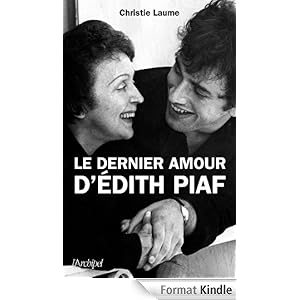
The Last Love of Edith Piaf - Interview with Christie Laume

You read it here first! I'm excited at bringing you a sneak preview of an amazing true story due out with Archipel Press later in 2014 and to welcome the author Christie Laume to my blog. This is the first time I've 'met' Christie but I feel I know her already because Jean-Daniel Belfond of Archipel asked me to translate her book 'Le dernier amour d'Edith Piaf' into English...

amazon.fr link
It was a dilemma for me. I've written 20,000 words of the third novel in the Troubadours series and it's going well so it's painful to break off with 80,000 words still to go. On the other hand, some opportunities don't come twice - or when it's most convenient - and I'm not one to say no to an adventure. To help me decide, I read the book. After that, I had to say yes . Who can resist the intimate detail, told for the first time, of a 46 year old French superstar's love - and marriage - with a beautiful man twenty years younger? This mature woman was hooked.

So I hope my readers waiting for the further adventures of Dragonetz and Estela will forgive the extra wait and consider my foster-book The Last Love of Edith Piaf, instead. When I read the book, I was struck not just by the love of the central couple but also the love of the author for her brother, the young man who was Edith Piaf's last love. I've translated a third of the book now and it's the perfect time to ask the author some of the questions that have come to mind, while I've been reading in French and writing in English.

About the author
Chryssanthi Lamboukas was born in Paris in 1942. When she was twenty, she was invited by her brother Théo and Edith Piaf to live with them and experience ‘the lifestyle of a star’, even though she herself was an unknown.  Prompted by motherly affection, Piaf wanted to launch the young woman as a singer and thought up her pseudonym, Christie Laume, under which name she made a number of records during the 1960s. She has lived in the United States since 1970.

Christie's first language is French but she has answered my questions in English, her second language. She also speaks Greek, which was the home language of her family. Her parents emigrated to Paris to escape war in their homeland but they never forgot their roots. 


Christie Laume photo by Eric Fougere
Bonjour, Christie. Your book is the true story of the love affair between Edith Piaf and a beautiful, talented man twenty years her junior – your brother Theo Sarapo. What made you decide to tell their story?

Many people ask me questions and they tell me because I lived with the couple, it would be good for me to tell the truth.  Also, I knew it was something I had to do in my life.

You show in the book how Theo was changed by his military service in the Algerian war and how your whole family lived in fear of losing him. What are your thoughts now, looking back on that time?

Theo changed in his military service during the Algerian war . Theo saw horrible things during that time and life had a different meaning for him .  When he finally could talk about it, I felt he wanted to live his life to the full, the way he wanted and not the way my parents saw it.

My parents loved their children so much and they knew Theo was in a terrible danger. It was a nightmare for them,  I understand them, I am a mother and a grandmother

On the surface, Edith and Theo seem mismatched; she’s a 46 year old superstar and he’s a 26 year old hairdresser when they meet. You lived with the couple so you knew them both well. How would you describe the relationship?

Edith was 46 and Theo 26, it was a big difference in age. They loved each other very much, they completed each other.  There love was above their age and above their physical appearance.  There love was so strong that they lived in their own world.

 How did people at the time react to them as a couple?

People had different reactions to them as a couple, some good, some bad. But after they saw how much they loved each other and how Edith was happy with Theo, people changed their minds.

When you describe your parents’ disapproval of the marriage, I was caught up in the realism with which you write. These are real parents, worried for their son’s future. Do you think they would have felt the same if the genders had been reversed?

At the beginning my parents had the same thoughts as other people about the age difference. Yes, they worried for my brother's future. If the genders had been reversed they probably would have accepted it better.

I love the way you show ‘behind the scenes’ and reveal so many realistic details of Piaf’s life, from eating habits to preparation for a concert. Where did you get all this inside information?

I had all this inside information by living with them in the same big apartment in Boulevard Lannes and also being with them during their concert tours.
  
Photo of young Christie Laume by Gerard Neuvecelle 


I get the impression that Edith had a profound impact on your life. In what ways did she influence you? 

Edith had a profound impact on my life at that time, she influenced me in many ways.  I was young and naïve.  I was raised in a very traditional  way.  I admired her great talent like every one.  But she knew my personality and she was very kind to me.

You had a career of your own as a singer. Did Edith give you any tips about singing?

Yes Edith helped me very much.  She told me how to be on stage, how to sing and how to pronounce each word. She took time to instruct me.

Do you think the USA, the UK and France have different attitudes to singers? It seems to me that French culture values the ‘chanson’ and its ‘interprete’ more than songwriting and the lyricist. I think it is more common in the UK and the USA to be a singer/songwriter and we don’t refer to a singer as an interpreter. What do you think?

I think the French have their personal ways to interpret  La Chanson. With their different ways of interpretation,  France, UK, and USA all have very talented people.

Edith herself did write some of her own songs but it’s not clear to me which ones. 

Edith wrote some songs.  Among these songs are  La Vie en Rose,  C'est l' Amour... But Michel Emer wrote  A Quoi ca Sert l'Amour .

What better way to finish the interview than by reading the extract from Christie's book that tells how this famous love song was born and by watching the two of them together performing their signature song.

PRE-PUBLICATION Extract from The Last Love of Edith Piaf 


When the spectacle at Olympia was in full swing and playing to a full house every evening, I found myself one afternoon at Boulevard Lannes in the company of Edith, Théo and Loulou Barrier. Michel Emer arrived. Michel was a well-known singer-songwriter, in Edith’s circle since before the war and already the composer of many of her songs. He seemed carried away with enthusiasm. He went straight to the piano and sat down, saying, ‘I have a song for you!’
He meant, ‘For Edith and Théo.’ He was already putting a sheet of paper on the music-stand. His fingers ran across the keyboard. He began to sing.
We listened to the whole song. It was absolutely perfect – at least in my opinion, even if I kept that to myself for the time being. Michel was right; the song told the truth about their life together. I could see that Théo and Edith were also excited. Loulou Barrier too.
Edith said straight away, ‘Stay at the piano, Michel. We’ll give it a whirl right now.’
Without further ado, they began to sing:-

A quoi ça sert l’amour?
On raconte toujours
Des histoires insensées
A quoi ça sert d’aimer?

What is the point of love?
We hear so much these days
Of mad and stupid ways
What is the point of love?

It was truly a wonderful song, which would soon be on everyone’s lips and on all our radios. The most extraordinary thing for me was to see its birth, in the emotion of an unexpected discovery. After a few attempts, Edith was so happy that she said, ‘We’ll put it into our repertoire.’
That was the beginning of a famous number that was to be repeated until the end of the season at Olympia. Edith would stop in the middle of her repertoire and wait for silence. Then she would turn sweetly to the wings and call, ‘Théo.’

Théo would reappear, moved, elegant, happy. He would come close to her and they would sing as a duo, ‘A quoi ca sert l’amour?’ Edith and Théo would be forced to give encore after encore. The fashion for duos was launched in Paris!

Copyright Archipel/ Christie Laume/ Jean Gill 2014

See Edith and Theo perform 'their' song

Thank you, Christie,  for being my guest and I hope you’ll come back to my blog for a virtual celebration when the book comes out later this year.


COMING SOON IN ENGLISH!

Théo Sarapo’s sister tells his story…


At the age of 26, Théophanis Lamboukas meets Edith Piaf, in January 1962. He is to become her second husband and the duo will perform her last big hit, ‘A quoi ça sert l’amour?’

When the star’s secretary, Claude Figus, introduces them to each other, Théo is so dazzled by ‘the Little Sparrow’ that he is speechless with emotion.  Smitten, Edith confides to Figus, ‘I want to see your friend again so I can find out whether he’s as smart as he is good-looking, because he hasn’t said a word all evening.’

They are driven to see each other again and Piaf encourages Théo to take up a career as a singer. She invents his stage name, Sarapo (‘I love you’ in Greek). They form a couple in life and on the stage, until Piaf’s death on the 10th October, 1963. Théo, her last love, joins her seven years later, victim of a car accident.

Their wonderful and tragic story is evoked here by Christie Laume; the singer’s last months as they’ve never been revealed before.


Wednesday, March 6, 2013

They called her 'Pony' - a free spirit

Welcome to author Kristin Gleeson, who is going to talk about her controversial biography of Anahareo, an Algonquin/Mohawk girl who grew up in a small Ontario town during WW1 and became famous for her marriage and conservation partnership with the man known as Grey Owl.

Amazon book link

Originally from Philadelphia, Kristin  lives in Ireland, in the West Cork Gaeltacht, where she teaches art classes, plays harp, sings in an Irish choir and runs two book clubs for the village library. She holds a Masters in Library Science and a Ph.D. in history, and for a time was an administrator of a national denominational archives, library and museum in America.

Kristin's website
Kristin ’s multi-talents include services to other authors and I can highly recommend the partnership she has formed with two other published writers; these are people I trust.  Check out Famelton Writing Services - their prices and services are clearly stated.

Kristin Gleeson is better known for her historical novel ‘Selkie Dreams’ so it makes a change for her to be interviewed about 'Anahareo', which was published the same year as 'Selkie Dreans', 2012, but with a different publisher, Fireship Press.

Welcome to my blog, Kristin.
Your book sparked off all kinds of questions! What made you write about Anahareo? Many people will be saying ‘Who is she?’

I was brought to the story oddly enough by seeing the film 'Grey Owl' (with Pierce Brosnan) one Christmas at my mother-in-law's in Cornwall.   My husband Dave and I talked about it afterwards and he pointed out that Anahareo was the story that should be told and I should tell it. 

How did you go about the research? You must be really pleased that the family love the book but did that give constraints on what you could write? Did you have enough material?

My Ph.D. focussed on women's history and I also have a lot of experience documenting and writing about Native American experiences.  Then began a five year journey trying to get to the sources and tease them out.   It isn't always easy working with Native Americans/First Nations because many have  a great distrust of outsiders of course and since Anahareo had short shrift in the past (and Grey Owl) they were naturally suspicious of me and my motives at first.  It took a great deal of time to build trust.   Also, I am living in Ireland and though I took trips to Canada, when I was there I was always working against the clock at an archives or with a family member who would dole out the material a little at a time. I had bad luck with the national archives because they brought the wrong boxes from across the river which meant that instead of 3 days examining the material I only had 2.   I was also financing it myself since, not being Canadian or Irish, I had no chance of getting grants to support the work.   So I didn't examine every piece of evidence.  That is for others, because now the papers are safely deposited in the Glenbow Museum.  My goal was to get her story out there, not put in the minute details.  

How amazing that you took the project on after seeing the film - I'd imagined you must have had a request from the family or some such personal connection. The practicalities of research are fascinating too.

Anahareo has been described as ‘the great woman behind the great man’. Is that how you see her?

I think Anahareo can stand in her own right.  Though she did inspire Grey Owl, she was also a woman whose own singular outlook and manner challenged the stereotypes society held about Native Americans. She didn’t wear a fringed buckskin dress or have her hair in long braids.  She was stylish with her bobbed hair and would on occasion wear makeup.  She never wore a dress, though.   She wore breeches and lace up boots and still managed to look a million dollars.  Few women would dare to wear that in those times, and fewer First Nations women.  She also was a prospector, could survive on her own in the bush and could paddle a canoe as well as any man.  She was campaigning for animal rights in her fifties, sixties and seventies, long after Grey Owl was dead.
  
What’s your take on Grey Owl? Many people saw him as a con-man when they found out, after his death, that Archie was really British, with no First Nation heritage at all.

I think Grey Owl truly believed that the best way to get his message out was to allow everyone to think he was First Nations.  He recognized that people, especially the British, would be more likely hear the message of the danger of the disappearing wilderness if it came from a First Nations man who they saw as close to nature.  He was under that spell to a degree, too (unlike Anahareo) and felt a great empathy for the issues First Nations people faced. 

Anahareo did finally gain recognition. She was invited to join the Order of Nature in 1979 by the International League for Animal Rights, an honour previously only given to Albert Schweitzer and in 1983 she was given Canada’s highest award, the Order of Canada. Why do you think these awards were given at this time?

Anahareo was awarded the medal of honour because of the guilt I think they felt for belatedly recognizing her contribution and Grey Owl's.   She campaigned hard in the 1960s and 70s for animal rights and for environmental issues.  Though I mentioned some of her appearances in detail, I didn't have the time to gather information for every appearance and felt that if I put it all in it would slow down the narrative. 

What came over to me was how hard Anahareo had to fight just to stay alive. Your book gave a new meaning to the term ‘pioneering spirit’ and I had no idea so many women prospected for gold (including Anahareo) But I found the poverty and alcoholism depressing.

It is a depressing story and the whole First Nations and Native American story is depressing.  I could go on and on why.  They are no more prone to alcoholism and drug addiction than anyone else, it is just that they face extreme poverty and its attendant health care issues, as well as unemployment, cultural restrictions and racism and many many more subtle obstacles.  The average life span of a Native American on the reservation is 45 for men and 48 for women.  With nowhere to go, nothing to do, why would you care if alcohol is bad, or eats your money, damages your kids?  I'll stop now!

amazon book link
Your novel ‘Selkie Dreams’ portrays a 19th century love affair between a feisty Irish girl and an Alaskan Native American man who embodies the culture. What draws you to write about that cross-cultural enrichment?

I’ve always been fascinated by other cultures and family seem to embody that cross cultural link with  links now to Thailand, Cuba, South America, Native Americans and the Jewish culture in my family.  I was tame and married a Cornishman and lived in the UK and now I live in Ireland, picking up on my own heritage. 

With regard to writing more generally, you have an exciting new venture in Famelton Writing Services. What are you offering writers?

I am really excited about being asked to join my two colleagues in offering consulting services to various writers.  We know from our own experience how tough it can be to break into the publishing world and we would like to help writers achieve.  Whether it’s someone who would like to have an experienced person review their manuscript to ensure that it’s has the important elements to make a good novel or non-fiction work or they just need someone to go through and help them polish it, we want to ensure their final manuscript is as perfect as possible.

Famelton Writing Services


What are your top tips for writers?
It may sound like a cliché but my very top tip for writers is to read as much as possible in the genre/type of novel/non-fiction work you feel drawn to write.  You’d be amazed at how much you can absorb that way in terms of good writing.

Do you seek outside input on your own writing? Is there one piece of advice that you feel has improved your work?

I think it’s so important to get a few different pairs of eyes on your writing. It’s amazing what you can’t see in your own work that you can see in others'.  But it can also assure you that you are on the right track too.   As for one piece of advice— other than repeat read, read, read—is to write, write, write.    Long ago I was told that ensuring there is a clear goal in the work—whether it is non fiction or fiction, is key to a successful narrative.  Your main character should have a clear goal in a novel and the non-fiction book should as well. 

You have two traditional publishers at the moment, Fireship Press for ‘Anahareo’ and Knox Robinson Publishing for ‘Selkie Dreams’; what are your views on traditional v self-publishing?

I think there is room for both in the market, though it’s changing so rapidly it’s difficult to make a reading.   Self publishing is becoming more difficult for those good writers who want to rise and become noticed.  I don’t think the cream rises to the top that easily.  There are just too many indies out there all trying to market their books, good or not.  Traditional publishing is fighting its own battles against Amazon and others who undercut the market with heavy discounts so that whether you are traditionally published or self published the author must promote virtually on their own.  That takes a lot of time.

Thanks, Kristin!

Thanks for such considered reading of the biography on ‘Anahareo’.  I feel sometimes like it doesn't get the attention it deserves.

Like Anahareo herself!

 .
Contact Kristin here


MY REVIEW of 'ANAHAREO'

When I was a little girl, crazy about animals, I had a Puffin edition of Grey Owl's book 'Pilgrims of the Wild' and I loved the story of wilderness, beavers and conservation. Later, I found out that Grey Owl was really Archie from England and his story became even more interesting. Knowing a fair bit about Grey Owl, I was curious about another aspect to his story as represented by this biography of Anahareo. I think this was the wrong attitude and I'll read it again - as Anahareo's story.

This is one of the dilemmas, not just in the book but in Anahareo's life; her husband was famous. Kristin Gleeson judges well how much to indulge our curiosity about Grey Owl while always focusing on Anahareo as the main character. The tempestuous marriage in log-cabin isolation through bleak Canadian winters was the backdrop to a revolution in thinking about animal welfare. Both Anahareo and Grey Owl were trappers, and the detail of trapping turned my stomach - as happened to Anahareo herself. She influenced her husband, and he influenced the world, to seriously consider the scarcity of animals such as beavers and start conservation projects. From prey to pets, the couple's beloved beavers became a symbol of changed attitudes. It’s one of the paradoxes about books on conservation that they inevitably detail animal cruelty/environmental disasters – horrible reading. That transition from trapper to animal lover is tough on the reader’s imagination, if you love animals, but it is real history.

Ironically, I never quite invested in Anahareo as a character in her own right, because I started with too much knowledge of Grey Owl and lost a little interest when he died - my fault, not the author's. I would have liked to know more about what exactly she did that won her the praise and medal towards the end of her life. The hardest thing about the book for me was that I found Anahareo’s life deeply depressing. I was expecting a pioneering spirit – and there was some of that (the rebel, bucking stereotypes) – but what came over to me was the poverty, loneliness, prejudice, alcoholism, loss of her children – and I was cut up by her and Grey Owl’s ignorance about animals (realistic, I know) and loss of the animals too, as they learned animal care by painful trial and error. Anahareo's life was hard.

I have had to rethink my naive, sentimental view of what 'pioneering spirit' actually means, especially for a woman who fought racial as well as gender prejudice in the early 20th century. I am in awe of Anahareo's physical endurance and survival skills. She was a beautiful young woman who dressed and worked like a man. She was capable of travelling alone for months by canoe and trek (carrying her canoe)to look for work - and she found it. Her father nicknamed her 'Pony' because she always needed to run free. 

A thought-provoking book; reading it will make your own life look different.

amazon book link