Wednesday, March 6, 2013

They called her 'Pony' - a free spirit

Welcome to author Kristin Gleeson, who is going to talk about her controversial biography of Anahareo, an Algonquin/Mohawk girl who grew up in a small Ontario town during WW1 and became famous for her marriage and conservation partnership with the man known as Grey Owl.

Amazon book link

Originally from Philadelphia, Kristin  lives in Ireland, in the West Cork Gaeltacht, where she teaches art classes, plays harp, sings in an Irish choir and runs two book clubs for the village library. She holds a Masters in Library Science and a Ph.D. in history, and for a time was an administrator of a national denominational archives, library and museum in America.

Kristin's website
Kristin ’s multi-talents include services to other authors and I can highly recommend the partnership she has formed with two other published writers; these are people I trust.  Check out Famelton Writing Services - their prices and services are clearly stated.

Kristin Gleeson is better known for her historical novel ‘Selkie Dreams’ so it makes a change for her to be interviewed about 'Anahareo', which was published the same year as 'Selkie Dreans', 2012, but with a different publisher, Fireship Press.

Welcome to my blog, Kristin.
Your book sparked off all kinds of questions! What made you write about Anahareo? Many people will be saying ‘Who is she?’

I was brought to the story oddly enough by seeing the film 'Grey Owl' (with Pierce Brosnan) one Christmas at my mother-in-law's in Cornwall.   My husband Dave and I talked about it afterwards and he pointed out that Anahareo was the story that should be told and I should tell it. 

How did you go about the research? You must be really pleased that the family love the book but did that give constraints on what you could write? Did you have enough material?

My Ph.D. focussed on women's history and I also have a lot of experience documenting and writing about Native American experiences.  Then began a five year journey trying to get to the sources and tease them out.   It isn't always easy working with Native Americans/First Nations because many have  a great distrust of outsiders of course and since Anahareo had short shrift in the past (and Grey Owl) they were naturally suspicious of me and my motives at first.  It took a great deal of time to build trust.   Also, I am living in Ireland and though I took trips to Canada, when I was there I was always working against the clock at an archives or with a family member who would dole out the material a little at a time. I had bad luck with the national archives because they brought the wrong boxes from across the river which meant that instead of 3 days examining the material I only had 2.   I was also financing it myself since, not being Canadian or Irish, I had no chance of getting grants to support the work.   So I didn't examine every piece of evidence.  That is for others, because now the papers are safely deposited in the Glenbow Museum.  My goal was to get her story out there, not put in the minute details.  

How amazing that you took the project on after seeing the film - I'd imagined you must have had a request from the family or some such personal connection. The practicalities of research are fascinating too.

Anahareo has been described as ‘the great woman behind the great man’. Is that how you see her?

I think Anahareo can stand in her own right.  Though she did inspire Grey Owl, she was also a woman whose own singular outlook and manner challenged the stereotypes society held about Native Americans. She didn’t wear a fringed buckskin dress or have her hair in long braids.  She was stylish with her bobbed hair and would on occasion wear makeup.  She never wore a dress, though.   She wore breeches and lace up boots and still managed to look a million dollars.  Few women would dare to wear that in those times, and fewer First Nations women.  She also was a prospector, could survive on her own in the bush and could paddle a canoe as well as any man.  She was campaigning for animal rights in her fifties, sixties and seventies, long after Grey Owl was dead.
  
What’s your take on Grey Owl? Many people saw him as a con-man when they found out, after his death, that Archie was really British, with no First Nation heritage at all.

I think Grey Owl truly believed that the best way to get his message out was to allow everyone to think he was First Nations.  He recognized that people, especially the British, would be more likely hear the message of the danger of the disappearing wilderness if it came from a First Nations man who they saw as close to nature.  He was under that spell to a degree, too (unlike Anahareo) and felt a great empathy for the issues First Nations people faced. 

Anahareo did finally gain recognition. She was invited to join the Order of Nature in 1979 by the International League for Animal Rights, an honour previously only given to Albert Schweitzer and in 1983 she was given Canada’s highest award, the Order of Canada. Why do you think these awards were given at this time?

Anahareo was awarded the medal of honour because of the guilt I think they felt for belatedly recognizing her contribution and Grey Owl's.   She campaigned hard in the 1960s and 70s for animal rights and for environmental issues.  Though I mentioned some of her appearances in detail, I didn't have the time to gather information for every appearance and felt that if I put it all in it would slow down the narrative. 

What came over to me was how hard Anahareo had to fight just to stay alive. Your book gave a new meaning to the term ‘pioneering spirit’ and I had no idea so many women prospected for gold (including Anahareo) But I found the poverty and alcoholism depressing.

It is a depressing story and the whole First Nations and Native American story is depressing.  I could go on and on why.  They are no more prone to alcoholism and drug addiction than anyone else, it is just that they face extreme poverty and its attendant health care issues, as well as unemployment, cultural restrictions and racism and many many more subtle obstacles.  The average life span of a Native American on the reservation is 45 for men and 48 for women.  With nowhere to go, nothing to do, why would you care if alcohol is bad, or eats your money, damages your kids?  I'll stop now!

amazon book link
Your novel ‘Selkie Dreams’ portrays a 19th century love affair between a feisty Irish girl and an Alaskan Native American man who embodies the culture. What draws you to write about that cross-cultural enrichment?

I’ve always been fascinated by other cultures and family seem to embody that cross cultural link with  links now to Thailand, Cuba, South America, Native Americans and the Jewish culture in my family.  I was tame and married a Cornishman and lived in the UK and now I live in Ireland, picking up on my own heritage. 

With regard to writing more generally, you have an exciting new venture in Famelton Writing Services. What are you offering writers?

I am really excited about being asked to join my two colleagues in offering consulting services to various writers.  We know from our own experience how tough it can be to break into the publishing world and we would like to help writers achieve.  Whether it’s someone who would like to have an experienced person review their manuscript to ensure that it’s has the important elements to make a good novel or non-fiction work or they just need someone to go through and help them polish it, we want to ensure their final manuscript is as perfect as possible.

Famelton Writing Services


What are your top tips for writers?
It may sound like a cliché but my very top tip for writers is to read as much as possible in the genre/type of novel/non-fiction work you feel drawn to write.  You’d be amazed at how much you can absorb that way in terms of good writing.

Do you seek outside input on your own writing? Is there one piece of advice that you feel has improved your work?

I think it’s so important to get a few different pairs of eyes on your writing. It’s amazing what you can’t see in your own work that you can see in others'.  But it can also assure you that you are on the right track too.   As for one piece of advice— other than repeat read, read, read—is to write, write, write.    Long ago I was told that ensuring there is a clear goal in the work—whether it is non fiction or fiction, is key to a successful narrative.  Your main character should have a clear goal in a novel and the non-fiction book should as well. 

You have two traditional publishers at the moment, Fireship Press for ‘Anahareo’ and Knox Robinson Publishing for ‘Selkie Dreams’; what are your views on traditional v self-publishing?

I think there is room for both in the market, though it’s changing so rapidly it’s difficult to make a reading.   Self publishing is becoming more difficult for those good writers who want to rise and become noticed.  I don’t think the cream rises to the top that easily.  There are just too many indies out there all trying to market their books, good or not.  Traditional publishing is fighting its own battles against Amazon and others who undercut the market with heavy discounts so that whether you are traditionally published or self published the author must promote virtually on their own.  That takes a lot of time.

Thanks, Kristin!

Thanks for such considered reading of the biography on ‘Anahareo’.  I feel sometimes like it doesn't get the attention it deserves.

Like Anahareo herself!

 .
Contact Kristin here


MY REVIEW of 'ANAHAREO'

When I was a little girl, crazy about animals, I had a Puffin edition of Grey Owl's book 'Pilgrims of the Wild' and I loved the story of wilderness, beavers and conservation. Later, I found out that Grey Owl was really Archie from England and his story became even more interesting. Knowing a fair bit about Grey Owl, I was curious about another aspect to his story as represented by this biography of Anahareo. I think this was the wrong attitude and I'll read it again - as Anahareo's story.

This is one of the dilemmas, not just in the book but in Anahareo's life; her husband was famous. Kristin Gleeson judges well how much to indulge our curiosity about Grey Owl while always focusing on Anahareo as the main character. The tempestuous marriage in log-cabin isolation through bleak Canadian winters was the backdrop to a revolution in thinking about animal welfare. Both Anahareo and Grey Owl were trappers, and the detail of trapping turned my stomach - as happened to Anahareo herself. She influenced her husband, and he influenced the world, to seriously consider the scarcity of animals such as beavers and start conservation projects. From prey to pets, the couple's beloved beavers became a symbol of changed attitudes. It’s one of the paradoxes about books on conservation that they inevitably detail animal cruelty/environmental disasters – horrible reading. That transition from trapper to animal lover is tough on the reader’s imagination, if you love animals, but it is real history.

Ironically, I never quite invested in Anahareo as a character in her own right, because I started with too much knowledge of Grey Owl and lost a little interest when he died - my fault, not the author's. I would have liked to know more about what exactly she did that won her the praise and medal towards the end of her life. The hardest thing about the book for me was that I found Anahareo’s life deeply depressing. I was expecting a pioneering spirit – and there was some of that (the rebel, bucking stereotypes) – but what came over to me was the poverty, loneliness, prejudice, alcoholism, loss of her children – and I was cut up by her and Grey Owl’s ignorance about animals (realistic, I know) and loss of the animals too, as they learned animal care by painful trial and error. Anahareo's life was hard.

I have had to rethink my naive, sentimental view of what 'pioneering spirit' actually means, especially for a woman who fought racial as well as gender prejudice in the early 20th century. I am in awe of Anahareo's physical endurance and survival skills. She was a beautiful young woman who dressed and worked like a man. She was capable of travelling alone for months by canoe and trek (carrying her canoe)to look for work - and she found it. Her father nicknamed her 'Pony' because she always needed to run free. 

A thought-provoking book; reading it will make your own life look different.

amazon book link


Wednesday, February 13, 2013

1,000 new readers - maybe

FREE KINDLE BOOK


Winner of Global Ebooks Award for Best Historical Fiction

Review 

'Highly recommended for fans of historical fiction' - Sharon E.Cathcart


Book 1 in the Troubadours Series
1150 in Provence, where love and marriage are as divided as Christian and Muslim.
A historical thriller set in Narbonne just after the Second Crusade. On the run from abuse, Estela wakes in a ditch with only her lute, her amazing voice, and a dagger hidden in her petticoats. Her talent finds a patron in Alienor of Aquitaine and more than a music tutor in the Queen's finest troubadour and Commander of the Guard, Dragonetz los Pros. Weary of war, Dragonetz uses Jewish money and Moorish expertise to build that most modern of inventions, a papermill, arousing the wrath of the Church. Their enemies gather, ready to light the political and religious powder-keg of medieval Narbonne


1,000 new readers

That's what I'm hoping for in the next 5 days, with 'Song at Dawn' free as a kindle and 3 print copies of 'Bladesong' on giveaway at goodreads. I'll update the Troubadours page on facebook with numbers of downloads each day, to see how close I get to the magic number of 1,000 new readers by Sunday night.

Nowadays, people collect free books without necessarily ever looking at them, let alone reading them, but here's hoping the one will lead to the other, and that reading Book1 will lead to reading Book 2.

This is the only book I've enrolled in amazon's exclusive program, and this is my first experiment with amazon's free days so I am curious as to how the whole process will work. I have given advance notices to book listing sites and considered what might work for me from Adele Ward's blog on going viral.

Now we'll see what happens!


Goodreads Book Giveaway

Bladesong by Jean Gill

Bladesong

by Jean Gill

Giveaway ends March 23, 2013.
See the giveaway details at Goodreads.
Enter to win

Monday, February 4, 2013

Don't stalk your readers!

The classic scenario:-

Bestselling author is stalked by psychopathic reader, who stakes out the author's house and sets physical traps, which the writer narrowly escapes. Moral; fans can be nutters - writers beware!

The modern version:-

Honest reader, who's written a negative review, is stalked online by psychopathic, self-published wannabe-writer, who pursues the hapless reviewer through blog and readers' groups. Moral; writers can be nutters - readers beware!

I want to meet you
Unfortunately, the modern version is all too real, a consequence of the new publishing world in which writer and reader can tweet and pinterest. I've blogged already about the democratisation of the review; nowadays Fred Bloggs' review on amazon is as useful to an author's ranking, if not more so, as James Joyce's review in 'The Times Literary Supplement'. Ranking improves visibility; visibility leads to sales. Some writers are willing to do anything - and I mean anything! - to get ahead in the modern goldrush, hoping to become ebook millionaires. The short time I spent on Harper Collins authonomy site (and blogged about here) horrified me, not just by showing what the writers were willing to do, but also what publishers actively encourage as 'marketing'. Spam and gang bullying, multiple screen persona to review your own books - the seedy underbelly of self-promotion is like some kind of crazy presidential race, corrupting all who join in.

In the last week, I've come across two true stories of readers who've been harrassed by authors to such a degree that one made formal complaint to the website administration and the other has closed his blog completely to reviews. There has been no action from the website admin; instead, the reader is the one affected, avoiding contact.

Both these readers have cut off contact with writers and are adamant that self-published authors are more likely to bully readers if they don't like reviews than are conventionally published authors. Whether this is true or not, it is very bad press for self-published authors and I'm hoping this blog post will make writers think twice before chasing after a bad review. Just the thought of a writer bullying a reader and challenging his freedom of speech makes me very angry! So much more angry than a bad review of one of my books would make me!

The bullies won't take any notice but there are writers being sucked into this marketing craziness, who don't mean to cause the upset they do; these are the writers I'd like to reach. Please don't contact someone who's given you a bad review. You won't change the review; you will lose the reviewer, and not just for your own books.

Remember that any review is better than none; I just read some interesting data suggesting that readers like to see a few reviews for a book. They feel comfortable buying such a book, even if the reviews are negative. If the reviews are controversial as well as negative - great! That's called publicity! You can make mileage out of it and quote negative reviews - elsewhere, and not in an attack on the reviewer.

Over the last fortnight, I've had my first experience of tweeted reviews on one of my books. I was lucky and 'Song at Dawn' found a reader who loved the book, so it was a pleasure to read the tweets. However, I did wonder how I would have felt if the tweets had been negative. It would have hurt, for sure, and I wouldn't have re-tweeted! But I can't even imagine 'going after' the reviewer! The freedom to be critical is what makes praise valuable; one without the other is meaningless.

Not only was it a pleasure to read the 'Song' review tweets, it was an education. There is a world of fanfiction out there that I know nothing about. Thanks to a lot of work by one reader, there is now a fun page of TVTropes about 'Song at Dawn' and I am amazed at how much fun people can have with books - and should have with books. If this particular reader had been put off self-published books by badly-behaved writers, none of this fun would have happened.

Don't stalk readers - respect them. Don't turn into their worst nightmare.

Nightmare man


Monday, January 28, 2013

Bladesong - party time!

Available now!


Available in print from amazon in March

The Story

1151 – the Holy Land during a fragile peace

Estela, the troubadour, following the destiny of
her beautiful voice, and Dragonetz, her passionate knight;
divided by the times they love in and fighting to be together.

Dragonetz is imprisoned in Damascus, his military prowess
as valuable and dangerous to the balance of power
as the priceless Torah he has to deliver to Jerusalem.

Can Estela get him out alive, despite Nur-ad-Din,
the Muslim Atabeg; Melisende, the Queen of Jerusalem;
and an avenger from the past?

Will she still want to,
when she knows what they’ve done to him?


Valentine Day Giveaways

Free Draw Giveaway of 3 signed print copies of 'Bladesong' from goodreads, 

open to entry February 13th - March 23rd


'Song at Dawn', Bk 1 of the Troubadours' on free DL as kindle from February 13th (US Pacific time) until February 17th


Extract from 'Bladesong', Chapter 6:-
Back in the Holy Land, Dragonetz re-lives events of the Second Crusade, trying to work out which of his enemies from the past is holding him captive now. In 1148, Dragonetz was a young knight, sworn vassal to Aliénor (Eleanor) of Aquitaine, trekking overland from Byzantium towards the Crusader State of Antioch. Aliénor, with her Commander Geoffroi de Rançon, is leading the vanguard of Frankish troops, with the baggage train in the middle and her husband Louis VII, King of France, bringing up the rear. Aliénor's party reaches one of the Crusade's infamous places, Mount Cadmus...


Although they were well into Seljuq territory, the day’s journey had gone without incident so far, and, at barely mid-day, they were already approaching the crest of Mount Cadmus, chosen for the night’s halt.
‘We pitch camp here for the night, my Lady.’ De Rançon steadied his grey beside her, snorts of steam showing the horses’ efforts on the climb.
Two sullen frown lines wrinkled Aliénor’s forehead. ‘That would be a waste of the time we’ve gained. Our scouts have reported a plateau but a few hours ahead, flat and fair, perfect for our camp. We should profit from our speed and continue. The heathens will never expect us to be upon them so soon and the element of surprise is worth ten thousand men.’

Before de Rançon could respond, de Maurienne pulled a face that would sour milk and abort sheep. ‘My King expressly instructed that we camp on Mount Cadmus for the night, where the goods-train and his own army will join us. Remember that the Germans were ambushed in this pass and we need to regroup as soon as we can.’
Twin points of hectic colour flared in Aliénor’s cheeks. ‘My husband,’ she emphasised the title, ‘has not seen the terrain here. Nor heard from scouts that all is clear. If he had, he would order this army to continue. The fact there was an ambush here three months ago means nothing! As the vanguard is under my orders, I command you, de Rançon, to continue with the day’s march!’


Dragonetz held his breath, in no position to intervene. The silence stretched.
‘Are you the Commander of my Guard or are you not, de Rançon?’ The ice in her tone was cutting, the threat clear.
‘At your service, my Lady,’ came the unequivocal reply. He was going to order them to march onwards.
‘No,’ shouted Dragonetz, jumping off his horse, clutching Aliénor’s bridle and stopping them all in their tracks. She glared at him.
‘You overstep yourself, my Lord Dragonetz. Be careful what you say next lest I find I have a traitor in my Guard.’
‘Dragonetz,’ warned de Rançon.

There was no going back and Dragonetz hoped wholeheartedly that there would be no going forward. ‘No,’ he repeated, more quietly, but the words still tumbled over themselves. Months of hearing bad advice leading to bad decisions welled up and poured out into this one attempt to stop lunacy. ‘My lady, if we continue, we are opening up the baggage train to attack. We cannot abandon them like this! The Seljuqs could be anywhere in these mountains. Those behind us will be slower, losing more and more distance from us, splitting up our army and making each section more vulnerable. Our horses need rest and our men must rally their strength in case they are called upon to fight. Our gains will show if we need to act in our defence.’

De Rançon leant down from the saddle and struck Dragonetz across the cheek with his glove, drawing blood. ‘You weren’t asked to speak.’

Aliénor held up her hand, stopping de Rançon from striking again. ‘He means well,’ she observed dispassionately. ‘We need men who care enough  to speak out.’ Dragonetz’ hopes rose. ‘Even when they’re wrong. There has been no sign of these Seljuqs who are supposed to be everywhere. Our scouts have reported the terrain clear. Louis will catch up to the others for a night here. And we can ride a few hours more to be better rested and in full possession of a perfect campsite. You should be thinking of attack not defence!’

Dragonetz dropped to his knees in the dust, still holding the reins of Aliénor’s mount. He unsheathed his sword and held the hilt out towards her. ‘By my oath to you, by all that’s sacred, I swear I would rather you kill me with the same sword by which you made me knight, than make this wrong choice.’

Her eyes flashed at him, impatient. ‘Enough histrionics, Dragonetz. I am not so easily swayed.’ She lashed out at him with a boot, kicking his hands off her reins and dropping his sword in the dust. ‘Leave me. I want only loyal men beside me. Give the orders, de Rançon, then ride with me. Let those who see bog-sprites and night-mares go back to Paris where they belong!’ As she spurred her horse into a canter, Dragonetz picked his sword out of the dust. His father’s men were with him in seconds, bear-like Raoulf and his golden son Arnaut, ready to kill or die for him, as he was for Aliénor.

‘You heard our orders,’ he told them curtly. ‘Tell the men.’ They’d been with him long enough to say nothing, but do exactly what they’d been told. Dragonetz ignored de Maurienne’s impotent clucking, mounted his horse and rode on along the Kazik Beli Pass, down the other side of the mountains until they reached an inviting plateau. There had been no attacks, not even one sighting of a Seljuq. The surroundings were clearly visible from the campsite and Aliénor was protected by de Rançon and her Guard, including Dragonetz’ men. Raoulf would rage at being given the slip but then if Dragonetz was to suffer Raoulf’s anger, they would both still be alive. He would take no-one with him and then he could take no-one down with him if he were wrong, for there would be a reckoning with Aliénor in either case.

Dragonetz apologised to his horse, left the army setting up camp and galloped like a raised ghost back along the route they’d just travelled, back to Mount Cadmus.


Sunday, January 27, 2013

International Emerging Writers

Author Laurence O'Bryan is collecting talent on his Blog and I'm flattered to be Number 4 in his 'International Emerging Writers' Guest Post series. I blogged about the pros and cons of different types of publishing, based on the fact that 'I've been published everywhichway except bestselling' - yet! Read my post here

It's well worth following the Emerging Writers' posts to discover a wide range of authors.

Post 3 was from Emy Award winner Gina London, a veteran journalist who's written a very personal book called 'Because I'm small and you love me'.

Post 2 was by mystery writer Arlene Kay about her Cape Cod whodunnit 'Die laughing'

Post 1 was by Andy Spzuk, on finding the right voice for his biography of his father's life in the Ukraine called 'Sliding on the Snow Stone'.

Published by Harper Collins, O' Bryan's conspiracy thriller 'The Istanbul Puzzle' was shortlisted for Irish Crime Novel 2012 and has now been followed by 'The Jerusalem Puzzle'. I'm hoping to talk Laurence into doing a blog interview some time soon but I might have to crack a few codes, survive a few attempted murders and recover from some hot dates in order to track him down somewhere in Ireland ...

amazon link

Wednesday, January 23, 2013

Steve Robinson news and reviews


Since my interview with Steve Robinson, there has been even more good news for the genealogical detective but sadly no advance on getting him to pose in the hat.


Interview with Steve Robinson
'To the Grave' has won the Indie Book Bargains '2012 best series book in crime, thriller & mystery' category.  It also came second overall in the votes.

The Feed-a-Read Top 10 sellers, backed by top publishers, features 'To the Grave' at Number 1 and 'In the Blood' at Number 2 for this quarter


amazon link
'The last Queen of England' is due out in paperback with a giveaway on goodreads to celebrate. Put your name in the draw here

That makes my reviews a bit of an anti-climax but here they are!


DESCRIPTION
Family history was never supposed to be like this...

When American genealogist, Jefferson Tayte, accepted his latest assignment he had no idea it might kill him. But while murder was never part of the curriculum he is kidding himself if he thinks he can walk away from this one.

Why can't I trace them?  What happened to them?

Driven by the irony of being a genealogist who doesn't know who his own parents are, Tayte soon finds that the assignment shares a stark similarity to his own struggle. Someone has gone to great lengths to erase an entire family bloodline from recorded history and he's not going home until he's found out why. After all, if he's not good enough to find this family, how can he ever expect to be good enough to someday find his own?


Set in Cornwall, England, past and present, Tayte's research centres around the tragic life of a young Cornish girl, a writing box, and the discovery of a dark family secret that he believes will lead him to the family he is looking for. Trouble is, someone else is looking for the same answers and they will stop at nothing to find them.

'In the Blood' - my review

A very enjoyable mix of detective story and historical novel.

Jefferson Tate, affectionately known as J.T., is a genealogical detective whose work stirs up family secrets, dead bodies and wild car chases, all delivered with panache. If you like fast-paced who-dunnits with Robinson’s extra ingredients of genealogy and period detail, you’ll love this series.

When J.T. is in one of his many potentially fatal situations, the plot has the fascination of a computer game, where you’re wondering how you would e.g. rescue a chained person from a flooding cave with a rope, a torch and the capacity to swim. Some of the narrow escapes are enjoyable for their ingenuity.

The idea is not only a winner but, as far as I can work out, original.  Robinson invented  this genre, which allows him to dip into whichever historical period fits J.T.’s research into a client’s family tree. I was impressed by the detail, whether of the 19th century storyline, or of the Cornish tourist trade – all convincing.

The central character is paunchy, flawed and likeable. He is driven by the gaps in his knowledge of his own family and by a passionate interest to uncover the truth – the classic detective, with the genealogical twist. Other characters are well-observed and created in cameo, but the pace doesn’t allow time for development. I’d prefer slower pace and time for relationships to mature but I think my hopes are doomed. J.T. lives in the fast lane.

amazon link

DESCRIPTION

Inspired by the author's own family history...

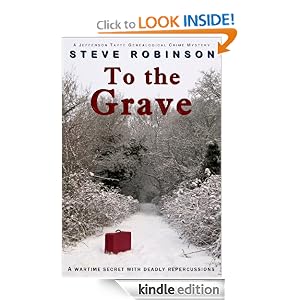
To the Grave follows American genealogist, Jefferson Tayte, as he uncovers the disturbing consequences of a seemingly innocuous act in 1944 that was intended to keep a family together, but which ultimately tore it apart. His research exposes hidden pasts and the desperate measures some people will take to keep a secret.

Sitting in a hotel room at gunpoint, facing an impossible decision, Tayte is forced to wonder how his latest assignment had come to this. Five days earlier, after a child's suitcase arrives unexpectedly at his client's home in Washington DC, Tayte embarks upon a journey that takes him back to England as he tries to unravel the story of Mena Lasseter - a girl whose life has become a family mystery.

Hoping to reunite his client with the birth mother she never knew she had, having no idea that she'd been adopted, Tayte's research draws him back to wartime Leicestershire and the arrival of the US 82nd Airborne, which irrevocably changes the course of Mena's life. But as Tayte tries to find out what became of her and why she was separated from her suitcase all those years ago, he soon finds that he is not the only one looking for her. Someone else is determined to get to Mena first and it quickly becomes apparent that their motive is a secret worth killing for.

'To the Grave' - my review

Expert story-telling.

I read this straight after ‘In the blood’, having enjoyed the first book. This is even better, giving us the same mix of modern genealogical detective work and narrative set in the past. In this book, we spend more time in the past, WW2, than with Jefferson Tayte, the likeably flawed genealogical detetctive.


The mystery turns around the search for a 66 year old’s real mother and takes us into the life of Mena, a teenager in wartime Britain. Robinson’s gift for empathy with a variety of characters, both male and female, brings Mena fully to life. The period detail is as realistic as the characters and this is one of those stories that you don’t just read – you live it.

Menaces and murders add to the excitement but are optional extras for me. It is the story of Mena that will live in my memory.

Sunday, January 13, 2013

Finding plots in cemeteries - interview with top crime writer Steve Robinson

Having now read two of his bestselling books, I'm very pleased to welcome the Genealogical Detective, Steve Robinson, to my blog. Whether he thinks he's a genealogical detective or not, is one of the questions I put to him...

Steve Robinson's website

About Steve Robinson


Steve Robinson was born in coastal Kent, UK, and now lives near London on the Essex/Hertfordshire border. His passion for writing began at the age of sixteen when he was first published in a computer adventure magazine and he has been writing by way of a creative hobby ever since.  When a career in telecommunications ended in redundancy he began to write full time.  His debut novel In the Blood was the result, with To the Grave following a year later.

Steve says  

I write for the crime, mystery and thriller genres with a family history angle, having become interested in genealogy as a means to tell the story of 'In the Blood' and perhaps because at the time I had no idea who my maternal grandfather was, which is something that has always intrigued me.  He was an American GI billeted in England during the Second World War.  A few years after the war ended, he went back to America, leaving a young family behind, and to my knowledge no further contact was made.  I traced him to Los Angeles through his enlistment record and discovered that he was born in Arkansas, but until recently that was all I knew.  Perhaps this is why my lead character is an American genealogist.  In August 2012, following correspondence with an amateur genealogist in Maine, New England, who wrote to me about my books, I learnt more about my maternal grandfather and my wider American family.  I hope to share that story on my websitesomeday.

Steve's latest book - a Jefferson Tate genealogical mystery

amazon kindle link

The story


HISTORY: from the Greek - historia. Knowledge acquired by 'investigation'.

It should have been a quiet weekend in London - a long overdue visit with the only true friend American genealogist Jefferson Tayte ever had. Now his friend lies bleeding in his arms and Tayte must follow his research to understand why, making him the target of a ruthless, politically motivated killer.

Working with historian Professor Jean Summer and New Scotland Yard on what becomes a matter of British national security, Tayte soon finds himself in a race to solve a three-hundred-year-old genealogical puzzle. It takes them all on a deadly, high stakes chase across London as Tayte tries to connect the pieces and work out the motive behind a series of killings that spans twenty years.

In what is Tayte's most personal assignment to date, 'The Last Queen of England' combines historic fact with fiction, challenging British history as we understand it. It uncovers a conspiracy that if proved could ultimately threaten an institution that has lasted more than a thousand years: the British monarchy.

Nullius in Verba: take no one's word for it.

Interview with Steve Robinson


Welcome, Steve! I first heard of your books because my husband had bought and read them all so then I had to read them too. I didn't realise at that stage that I'd be lucky enough to interrogate you on my blog. As far as I know, you invented the genre of genealogical whodunit, which is pretty impressive these days, when everything seems to have been done before. Why do you think so many people are interested in climbing their family tree?

I think it’s part of the human condition to be curious about who we are and where we came from.  Genealogy helps us to answer that question and with so many records now being digitised and being made available online, our ancestry has never been more accessible.  The exploration of our own family connections can also breath life into the past as our ancestor’s stories are uncovered, and then there’s the allure of all those skeletons in the family closet waiting to be found.  I think it’s easy to see the attraction.

Your main character, the likeably paunchy and flawed Jefferson Tate, fondly known as JT, is an American genealogical detective and the details of his work are very precise. Are you a genealogical detective yourself?

Not professionally, although I’ve become something of an amateur genealogist over the years since I started writing my genealogical crime mystery series.  I have to become one to some extent when I’m writing or my books would lack credibility.  I essentially give myself a problem to solve - or rather, a brick wall for JT to climb.  At the time I usually have no idea how he’s going to climb it, so I have to work it out as any genealogist might.  I feel JT’s frustration, too.  There’s a scene in 'To the Grave' when JT is in his hotel room, trying to find someone, and he literally has no clue as to how he’s going to do that.  The records he needs to see either don’t exist or are closed to him.  So he stays up all night and grinds it out - and I remember with great clarity doing that with him.  It wasn’t easy and it took me much longer than it took JT in the book, but we found a way and I think that also helps to keep it real.

How do you research your books?

Once I have a high-level plot worked out, I carry out similarly high-level research, just to make sure everything works and is feasible.  If I’m writing in a particular time period I also research that early on.  Once I’m ready to start writing, I research each chapter as I come to it in greater detail.  I never feel that I can do enough research, but writing with authority in any given subject is as much about what you leave out as what you put in or your writing can become too instructional and seem to lack real confidence that only comes from understanding what you’re writing about.  With historical scenes I feel I have to know enough about the time and place to feel a part of it.  Only then do I feel that I can write those passages in such a way that the reader will be there with the characters when they’re reading about them.

Before this interview, I read ‘In the Blood’, so I could read your books in order, but I really like the look of the second one, based on your own story. J T says, 'If you can’t find this family, how the hell do you expect to be good enough to find your own?' Is that personal search part of your own motivation in writing?

I don’t think it’s why I write, but it’s certainly a part of why I write about a genealogist who has no idea about his own ancestry.  And it’s definitely why I wrote 'To the Grave', perhaps as a way to fill in some of my own unanswered questions with some facts and plenty of fiction.  I’m honestly not sure why I feel the need to write, but the need has always been there, as I suspect it must be with every writer.  I suppose it’s because of those voices in my head that I have no control over - the dialogue snippets that keep coming to life in my mind that I feel compelled to write down,  but I’ve no idea where they come from.

As a British writer, how difficult was it to create an American character and setting?

I wouldn’t say it I found it difficult at all.  Whether it’s people or places, it’s all down to the research and the differences are really very small.  There are language differences to understand and it’s important to get it right.  When JT’s speaking or I show his direct thoughts I endeavour to ensure that what he’s saying sounds authentic without overdoing it, but other than that, he’s just a man with a penchant for tan suits and Hershey’s miniatures.  I also visit the USA and Canada once every year or two, which helps, and if you’ll excuse the pun, being a quarter American on my mother’s side means that it’s in my blood.

Nice pun :) I felt you really knew the Cornwall location in ‘In the Blood’. How important is setting to you?

I’m a frequent visitor to Cornwall and love it for it’s rugged beauty and the escapism it offers.  It felt easy to write about the area because I’ve come to know it so well and because it’s such an evocative place to write about.  One reader paid me a great compliment in a review for 'In the Blood', saying that the scenery came to feel like another character in the book.  Cornwall gets to you like that.

Your route to self-publishing success included 5 years of rejection by traditional publishers. What are your views on self-publishing versus old-fashioned publishing?

I’m for any kind of publishing that helps a writer to be read, and since the advent of the eBook, the opportunities have never been better.  I resisted publishing my work independently for a long time, hoping that the next book and then the next would be the one, but after getting an agent with 'In the Blood', and after getting so many promising rejections from the big publishers, I decided that my work deserved a chance.  Above all, I believed that readers would enjoy it and I’m just so happy that that’s proving to be the case.

It's good to see you having that success and an inspiration to the rest of us treading the independent road. Which services, if any, do you out-source? Jacket design? Print book creation? Formatting?

I suppose I’m about as independent as an independent author can be as I do all those things myself, although I’m fortunate enough to have made a few friends along the way who proof read my books and find the things I miss prior to publication, which is as invaluable as it is appreciated.

What tips would you give authors on making a success of self-publishing?

I’m sure there are many, but I’ll highlight a few things that stand out for me.  It’s not always possible to come up with something new, but looking for a new approach to something that’s already established is the next best thing.  And be realistic about pricing.  You don’t have much choice when it comes to paperbacks, but for eBooks you do.  It’s a very competitive market and if no one knows who you are, you can’t really expect them to pay a high price for your books.  Many eBooks are also free of course and plenty of big-name-author’s eBooks can be bought for under a pound/dollar.  When I started out, I sold my debut book as cheaply as I could in the hope of growing a readership, so once someone had found my book, I didn’t want price to be a barrier.  Also keep in mind that it’s a long-term business and it takes some patience to establish yourself.  And keep writing.  Every book in publication increases the chance that someone will find you.


There are three JT novels now. Do you have ideas and plans to continue with the series?

Yes, I’m planning at least three more books in the Jefferson Tayte Genealogical Crime Mystery series.  After that, who knows?  Maybe another series if the demand is there, and if JT survives of course.  I don’t like to know too much about what’s in store for my characters.  I should think I’ll be plotting like crazy until the summer, and it will be a while before book four is ready, but I’m hoping there will be less of a gap between that and the following books as I’ll have already completed much of the plotting and research for them by then.  The next books in the series will be also more closely linked.

Glad to hear there are more on the way - and I know my husband will be! How long do you take to write a book and what stages does it go through?

The three books I’ve published each took a year to write, but that’s not really all the time that’s gone into them.  They’ve been through extensive rewrites since I first wrote them, so that they would better fit into the series that began when I published 'In the Blood'.  Once I’ve worked out the theme and have the general gist of the story, I’ll do some research and other ideas often come from that.  Then I’ll think about the ending and start plotting in earnest, working towards that end.  This is when I start to weave all the sub-plots in.  I didn’t plot that much with my first book and I ended up with 165,000 words and a lot of headaches, backtracking the plot and then cutting content, so I plot more thoroughly now and try to write a tidy first draft of about 100,000 words or so.  I’ll go through four or five drafts before I’m ready to let anyone else see the book, then my wife reads it.  I’ll then do another draft, set a publication date and send it out to proof readers.  I do a final polishing draft about a week before publication and I publish the eBook first as it’s easy to make corrections to the digital edition.  A month or so later, I set the paperback edition rolling, then I get cracking on the next book, having had a natural break from writing while I’ve been publicising the new release.

It's interesting to hear the detail of your re-writing - so few people realise how much work goes into books as good as yours. What would you say is your most interesting writing quirk?

I’m sure it’s not particularly interesting, but perhaps it’s quite quirky that I wear an old olive-green bucket hat when I’m writing.  I started wearing it to keep the sun out of my eyes when writing in my kitchen, and then I found that it also helped to focus my attention on the words in front of me as it cuts out my peripheral vision.  In his book, On Writing, Stephen King suggests that you put your desk in a corner of the room, away from the windows.  I suppose my bucket hat has become my way to eliminate undesirable distractions wherever I’m working.

You should have an author photo with the hat! Like Terry Pratchett. What was one of the most surprising things you learned when creating your books?

That would have to be when I learned the whereabouts of my American GI grandfather.  I now know that he was buried in a military cemetery in Los Angeles in 1990.  I didn’t expect to discover that through my writing.  It came about following an email from another writer and amateur genealogist in Maine who initially wrote to me to say that she’d enjoyed reading 'In the Blood'.

Do you hear from your readers much? What do they say?

I get emails most days and feel both flattered and humbled to think that someone has taken the time to write to me.  I love receiving them and they’re typically written to express thanks for the enjoyment my books have given, which is wonderful.  Some readers also share a little of their own family history or talk about one or more of my books in greater detail.  I always reply and I’m surprised at how unexpected that can be.  It seems the least a writer can do in return for the kind words and support, and I hope to be able to continue writing back no matter how many emails I receive.

I noticed that you make your contact details readily available in your books and I've started doing the same, following your lead. 

I believe that you’re a keen photographer. What gear do you have? What do you enjoy about photography? 

I’m just getting back into SLR photography after a break of about twenty years, and as I create my own book covers I thought it was about time I got some decent equipment.  I’ve used Canon digital compacts for years so I stuck with Canon for the DSLR.  On one level I enjoy the creativity, and on another I like seeing the detail in the world around me that I can’t easily see with my own eyes - such as with macro photography and photos of wildlife.  I also enjoy the challenge of getting close to wildlife to get the shot.

What else do you like doing in your spare time?

You’d think a full time, independent author would have plenty of spare time to play with, but I don’t seem to find much lately - or don’t allow myself much between the writing and the marketing and keeping the house and garden tidy.  Not that I’m complaining about anything - I’m really enjoying it - but publishing is a business like any other and you have to put the hours in if you want it to be a success.  When I do switch off, I have a guitar that I started to learn - and now need to pick up more.  I like to play golf and there’s the photography of course, which I’m also hoping will encourage me to take more regular walks.  Spare time activities seem to vary, depending on what part of the writing process I’m at.  When I’m plotting for instance, I often find that I need to just walk away and do something else, particularly if I’m trying to solve a major plot issue - the answers to which invariable come when I’m not actively looking for them.

Thank you, Steve, and what are you doing chatting to me? Get back to writing the next JT novel! Your fans are waiting. My reviews of Steve's first two books will be in my next blog post.


Keep up to date with Steve Robinson's news and read his other interviews on his website


Next Blog my reviews of
amazon link
amazon link