Showing posts with label publishing. Show all posts

Friday, June 30, 2017

A picture paints a thousand … dollars


The 13th Sign copyrighted Publisher logo
As writers, we want images for our book covers, blogs, adverts and tweets. It is so easy to break the law if I find the perfect picture online. All I have to do is right-click, save it and use it. Simple! As simple as picking up sweets in a shop and pocketing them. You probably wouldn’t do the latter because a) it’s stealing and b) if you get caught, you don’t just pay the price of the sweets. The same applies to using images without permission and there are some horror stories doing the rounds about the price of being caught.

I’m a writer and a photographer, with a stock portfolio of 3,500 photos at istockphoto and Getty Images. When you buy a stock image, you pay for a license to use it and have the security of knowing you are not breaking any laws. The photographer remains the copyright holder and can earn a living through multiple small sales. If you use any photo without payment (if required) or permission, you are stealing from the photographer.

You would be surprised at which photos sell best. How much do you think each of these photos has earned for me?


Untidy Wardrobe istockphoto file link


The untidy wardrobe has earned $400 and the swamp hag, which involved a gutsy paid model, complicated lighting and a unique (!) location - $20. The wardrobe photo is successful and the swamp hag is not (though of course I love it). If somebody saw the wardrobe and thought, ‘That’s just an ordinary photo; why shouldn’t I use it – and I’ll pay if I get caught,’ I’d lose my income.
All this is a bit heavy when all you want is a little picture for your blog?

You have three legal options. 

1) You could use a photo that is ‘free to use without restriction’ often stated to be ‘under creative commons license’. Here are two of the many sites that offer photos free, even for commercial use.

Pixabay is a gateway to shutterstock and many of the paid stock libraries offer freebies as a taster. Help yourself!
The New York Library is also one of many sites offering free photos. Be careful. Some ‘free sites’ steal photos. You could be in trouble if you use images these sites should not be offering.

A creative commons license does NOT automatically mean that you can do anything you like with a photo. You need to read the terms of each photo, which might limit the use or require credit in a given manner.

2) You can pay for Royalty Free stock photos. Royalty Free does NOT mean free. It means you can use the photo in advertising (e.g. book jackets) and combine it with other images in any way you want. You can Photoshop it to death. Check the license use if you have a bestselling print run – you might need an extended license (usually at about 500,000 copies).

Credit your source where possible and, if you can, the photographer by name. These are your creative colleagues and, if you use one of my photos, let me know and I will publicise the fact! Photographers are your marketing friends!

3) The third option is to use your own (or a friend’s) photos. You avoid all the legal problems that way, right? Wrong. 

Photos that are fine for personal use might be illegal if used commercially and it is your responsibility as photographer (and publisher) to obey the law. Your human subjects have rights so you should have permission from them before using their photo as e.g. a book jacket. Some buildings are copyright protected so you could be sued for using a photo of e.g. the Eiffel Tower at night, without permission.

I mentioned ‘Royalty Free’ photos. Every human subject in my photos has signed a Model Release permitting sale of their photos. There are no brand names, logos or copyright places. As a photographer, you could be sued over any of these issues.

The exception is when you use or sell your photos as ‘Editorial’. This is photo-journalism; travel, news or street photography where you do not always have model permission. Editorial photos can only be used in a reporting context and cannot be changed (i.e. Photoshopped or cropped in a way that changes the context). Laws vary by country but, for instance, even for Editorial, my companies do not allow photos of one child unless model released; several children or a child with at least one adult are acceptable.

If these were your photos, which of these could you legally use for a book cover?


Lyon Old Quarter istockphoto file link


Collioure Harbour istockphoto file link


Answer: all of them require Model Releases or can only be sold for Editorial use. This means that you could use them for a non-fiction (e.g. travel) book but if anybody can be recognised, it’s always safer to have permission from the subject. Number 2 (man hiking) does have a Model Release so is for sale Royalty Free. 

Because we photographers are lovely people, this photo (Romance in Paris) is a gift to you from me, free to use without restriction. Credit is always appreciated and if you let me know of any use, I will publicise that – I love seeing my photos ‘in the wild.’ Incidentally, photographers still own copyright to a photo even if there is no name or watermark on it, or embedded identifying data. Those are mere reminders to viewers that the photo is copyright – they don’t change its status.


If you’re not sure it’s OK then it probably isn’t, so unless you’re willing to go to court, don’t take risks. The main rule is to respect others’ copyright as much as your own and to appreciate that a photographer’s subjects (human and property) have rights too. Only use photos you have permission to use, in the way that you are using them.

I am NOT a lawyer so the opinions given here are based on my experience as a photographer, author and publisher.

You can see my stock portfolio here 

You can see my fine art photo galleries here

First published in 2016 in ALLLi's Self-Publishing Advice Centre 

Sunday, November 9, 2014

Amazon's Pre-order Option - making the most of it


Is it really 3 months since amazon opened the pre-order option to Indie writers? 3 months since I was excited enough to blog about it? 'One Sixth of a Gill' was duly published on November 1st and in the afterglow of post-publication, did pre-ordering add to the fireworks? Is it a good idea? 

To pre-order or not to pre-order

My tips:-


-2. Get editorial reviews (positive quotes and permission to use them) from readers who like the book and, preferably, have some status either to do with the subject or the book world.

-1. Approach professional bloggers/reviewers who often require months' notice pre-publication. (e.g. Foreword - 2 months in advance to even be considered for a free review) Use your editorial quotes in your formal request for review. You can still get professional reviews at a later stage; the going rate is $80-$400. Yes, this world is so crazy you can pay $400 for a 450 word review - more than most authors ever make for writing a novel. Yes, I think that is outrageous.

1. You need a near-finished version of the final ebook and your polished, perfect jacket. You can change both before D-Day but your cover is your book's image, literally, so changing it is not a good idea. Amazon requires proof of life in the form of an ebook file that is a book-to-be, if not the final edit, or it won't be accepted for pre-order. I don't know whether anyone has had a book rejected but I wouldn't risk it. 

If you do upload a new book jacket you must re-click on pre-order (2nd page) not save as draft or the new jacket won't appear. Whenever you re-click on pre-order the project is locked for 24 hours and 5 days before D-Day the whole project is locked, full stop, in launch position and no change possible.

2. Set your publication date. I liked having a date to focus my marketing and it made the online party planning easier. My goodreads giveaway finished on 1st November; my facebook launch was on 1st November; reviewers of advance copies were asked to post on or after 1st November. Your book needs to be uploaded in its final version a week before publication date or amazon gets cross and withdraws pre-order rights for a year. Apparently, the same applies if you try to play games with the publication date to up your rank by combining pre-orders with launch-day sales; I don't play games so I don't know.

My big problem with the publication date was with the print book. I could not control this exactly in the same way so I published it ahead of e-book D-Day. This highlighted all kinds of interesting consequences (see below)

To decide on a date make sure a) you'll have the book in its final state and b) you'll have completed all the buzz build-up you planned - make a list backwards from D-Day.

3. Your pre-order book gets its amazon page. Great! You can - and should - put editorial reviews and link to your amazon author page. Make it look good because this is a reader's first impression of your book. You can use the page to approach bloggers and reviewers but they are more likely to read (and review) your book if they read reviews on your page. Yes, the dreaded catch 22 - hence the -1. stage in planning - get some review comments first, even before pre-publicity.

please


Look at your page as if you don't know it. Let's assume you have a great jacket and blurb, and that genre is obvious. Many readers like to 'Look inside' - stop there. No 'Look Inside' until publication date. Great blurb - no, wait. It looks awful. It has lost all formatting so there's no spacing, no italics/bold and the main bit of your blurb drops below 'Read more' so if readers can't be bothered to click on it they've missed your irresistible hook.

Go to amazon author central on .com and re-format so your description looks good, so your editorial quotes look good, so your author comment looks and so your dog looks good! You get the idea. Then, with a large pillow to hand, go to amazon.co.uk It all looks completely different. Either cry into or bash your head against the pillow (depending on temperament) then adjust via amazon.com author central - again. The changes there feed into .co.uk but not vice versa. I once spent happy hours creating a new author page on amazon.fr (as I live in France) to discover that I'd created my twin - another me, with the same name. It took me many anguished emails in franglais to murder the evil twin. Be warned!

One really good feature on the book page was the row of books along the bottom with amazon's 'readers who viewed this item also viewed...' Not only did it pretty up the page but it gave me an early indiaction as to where my book fitted into amazon's categories. Speaking of which, I had time to contact amazon and get the book into the right categories before D-Day.


4. What about the print book? I used Create Space this time and wanted to bring out the print book on 1st November. Neat! Er, no. Impossible, more like! Amazon does not allow mere Indies to have a pre-order facility for print books, even via create Space. Bad show, amazon! There is a workaround using Amazon Advantage but my brain had more than enough to worry about so I passed on that. As soon as I read that there had been a hic on timing and delivery, I thought, 'Nope.'

So I brought the book out a bit early but didn't publicise the fact, except to a couple of early reviewers. I asked amazon to link paperback with ebook and hey presto! the pre-order ebook now had reviews showing (otherwise not possible until publication date). Also, the ebook now had a 'Look Inside' facility - showing the print interior until the ebook was live. Useful!

If amazon doesn't review its policy re pre-order for print books from Indies and/or posting of reviews on Indie pre-order books (both option are available to the big publishers, who are happily using amazon's ring-fenced Vine review system to get advance reviews on pre-order pages) then I would seriously look at publishing the print book first to get all the material I want on the ebook page.

5. Party all-day! The facebook launch party on my author page was a great success and there are still stragglers lying around, drunk and happy :) Gatecrash and take a look if you want to see what a real party looks like. I loved the way amazon released the ebook at midnight in each different amazon time zone - it was like New Year's Eve (but then I had overdone the champagne). To see so many people drop by was fun. 

Conclusion
I feel a bit foolish as there are so many clever, bestselling Indie writers out there crunching numbers and giving advice on how to work the system but perhaps my bumbling methods can offer a different viewpoint. The pre-order option organised my lead-up to publication and I think that's important. and I have definitely had a boost to sales of all my books in the last couple of weeks. 

It usually takes me two or three years to write a book. 'One Sixth of a Gill' simmered over many years.That is the kind of writer I am and the kind of book I write, so any marketing techniques will have to fit my workflow, not the other way around. I'm never going to take advice like 'write a book every 90 days' but if you do, there are further tips in two excellent blogs, which will suit you.

If you want an analysis of pre-order's impact on ratings and ranks, Angela Quarles is much better at all of that than I am; here's her clear report on using amazon pre-order for a debut author. Another helpful blog on the subject, especially if you write books a lot more quickly than I do, is Susan Kaye Quinn's. Susan also has a neat way of gaming the system re print books - and in this case, I'm not against gaming!

As for me, I'm off back to the 12th century...

am writing


Monday, January 6, 2014

What's in a name?


If it's a book title, the name is crucial! 

Choosing a book
What if Fifty Shades of Grey had been called Disempowered two-dimensional woman gets sexually abused by equally two-dimensional rich, sadistic man ? ** Disclaimer ** I haven't read Fifty Shades.. and am creating a phony title, based on random negative reviews of a bestseller, to make my point. Please don't sue. My point being that I think Fifty Shades of Grey is a great title. It is short, memorable, thought-provoking, rich in double meanings, metaphorical, indicates genre and is original (as far as I know).

A book title has two jobs; to attract readers and to accurately represent the content. It is married to the book jacket and if they're heading for a divorce, the reader will be put off spending time in their company. If Fifty Shades of Grey had a cover image of a happy two-parent family, with a cute dog, on the jacket, the potential reader would be confused, especially after reading the blurb (the small print in the implicit contract between writer and reader). If title and jacket do a brilliant job of attracting the reader but the book is then nothing like expected, the reaction will be disappointment and negative comments about the writer. You can't please everyone, or cater for all subjective reactions, but you can at least try to find the right readers for the book you've written, by using current 'first impression' conventions.

If you don't care whether readers enjoy your book, or come back to read another one by you, as long as they buy this one, none of these principles apply to you. Most of us writers, however, get our kicks from the readers who love our books - and that means finding readers, yes, but also finding a good match between readers and books.

Finding a title you're happy with is difficult and whether it's a 'good' title is for other people to judge. When I'm planning a book, I have a working title that might change many times before publication. I always look up my title on amazon to see whether it's been used already. If so, I think again, unless the title is out of print or in a niche that doesn't clash with my book. If there are similar titles, I consider their genres - if they are all in a very different genre to my book, I am on the wrong track for reader expectations.

I do test the title (and jacket) out on other people, and consider their feedback, but once the book is written, I work on gut instinct to recognize the title that fits. That's how it feels to me; not like creating a title but like finding it. I feel the same about naming dogs; you can come up with beautiful names in advance but when you actually see the living creature, you know he's called Spud, and that's just how it is.

Working as I do is terrible for advance marketing - how can you work up reader enthusiasm for a book with no title? As with many aspects of writing, there is a clash between what suits me as a writer and what is best marketing practice. If I'm not sure about the title, I would rather wait till I know it for sure than regret the choice forever. If I'd gone with the first working title,

Snake on Saturdays would have been Twisted Yarn. The heroine runs a hand-knit business and I liked the double meaning. One of my failings is to laugh at my own jokes but I now think Twisted Yarn is a truly awful title for a novel.

Someone to look up to would have been Sirius, after the main character, a dog. Not so bad as a title but 'someone to look up to' is such an important concept in the book, that I didn't understand until I was writing, and that was a revelation for me as well as for Sirius. I love this title.

Bedtime story

Gentle Dog Training, my translation of Dressage Tendresse was not just a book title but a method of dog training and I had to fight my corner to avoid Tenderness Training (a great alternative to Fifty Shades of Grey), or Train Me Tender and all kinds of ambiguity.

On the Other Hand would have been Sinister because the word 'sinister' originally just meant 'left-handed' and left-handedness is a theme in this YA book, which mixes fact and fiction. The Romans thought left-handed people were untrustworthy because they could shake hands with their right hand while stabbing you with the left, hence the more sinister meaning of ... sinister.

Here are the more recent ebook jacket and the original print jacket for On the other hand My publisher told me that we'd made one mistake - On the other hand starts with three words that get ignored in searches so the title doesn't show up unless you add my author name. You live and learn! Avoid using more than two high frequency words at the start of a title.
amazon link


Sometimes, the title just works, right from the start. My bestseller How Blue is my Valley took its title from the Welsh classic How Green was my Valley  and the 'blue' from the lavender of my current home in Provence. It just seems right for a book about someone moving from Wales to Provence and comparing the two. Alluding to a phrase or title with which readers are already familiar can work but it can also backfire as readers sometimes react against what they see as an attempt to cash in on fifty shades of copying.

I wish it was always so easy to find a title that suits! I have about twenty potential titles for the third novel in my 12th century series about Estela and Dragonetz but am not sure yet. The working title is Eaglesong but that's probably too suggestive of fantasy rather than historical novel and I don't know what eagles have to do with anything, apart from the castle and (probably) main setting being on high rocks. As it follows Song at Dawn and Bladesong, I thought Song somewhere in the title would link the series. I'm hoping all will become clear to me as I write.

Thanks to advice from fellow authors, I am also a big fan of the subtitle or tag as this can clearly indicate genre and add extra keywords to show up in online searches. I am sure that adding the real Provence in small print below How Blue is my Valley has helped find readers. For the Troubadours series, I've used date and place so I now have another headache as 1150 in Provence was used on Song at Dawn and now my characters are back there,  I don't really want 1152 in Provence... decisions, decisions, which I will have to make before the book jacket goes live.

Perhaps I should work the other way round; take a great title and write the book that it deserves. Helpful friends often suggest, 'You should write a book on..' and occasionally I'm even given titles. Drug Mule to Merthyr really ought to be written by someone but Going Home to Dai is more my style.

aggressive marketing


Sunday, January 27, 2013

International Emerging Writers

Author Laurence O'Bryan is collecting talent on his Blog and I'm flattered to be Number 4 in his 'International Emerging Writers' Guest Post series. I blogged about the pros and cons of different types of publishing, based on the fact that 'I've been published everywhichway except bestselling' - yet! Read my post here

It's well worth following the Emerging Writers' posts to discover a wide range of authors.

Post 3 was from Emy Award winner Gina London, a veteran journalist who's written a very personal book called 'Because I'm small and you love me'.

Post 2 was by mystery writer Arlene Kay about her Cape Cod whodunnit 'Die laughing'

Post 1 was by Andy Spzuk, on finding the right voice for his biography of his father's life in the Ukraine called 'Sliding on the Snow Stone'.

Published by Harper Collins, O' Bryan's conspiracy thriller 'The Istanbul Puzzle' was shortlisted for Irish Crime Novel 2012 and has now been followed by 'The Jerusalem Puzzle'. I'm hoping to talk Laurence into doing a blog interview some time soon but I might have to crack a few codes, survive a few attempted murders and recover from some hot dates in order to track him down somewhere in Ireland ...

amazon link

Sunday, January 13, 2013

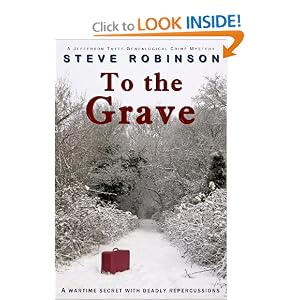
Finding plots in cemeteries - interview with top crime writer Steve Robinson

Having now read two of his bestselling books, I'm very pleased to welcome the Genealogical Detective, Steve Robinson, to my blog. Whether he thinks he's a genealogical detective or not, is one of the questions I put to him...

Steve Robinson's website

About Steve Robinson


Steve Robinson was born in coastal Kent, UK, and now lives near London on the Essex/Hertfordshire border. His passion for writing began at the age of sixteen when he was first published in a computer adventure magazine and he has been writing by way of a creative hobby ever since.  When a career in telecommunications ended in redundancy he began to write full time.  His debut novel In the Blood was the result, with To the Grave following a year later.

Steve says  

I write for the crime, mystery and thriller genres with a family history angle, having become interested in genealogy as a means to tell the story of 'In the Blood' and perhaps because at the time I had no idea who my maternal grandfather was, which is something that has always intrigued me.  He was an American GI billeted in England during the Second World War.  A few years after the war ended, he went back to America, leaving a young family behind, and to my knowledge no further contact was made.  I traced him to Los Angeles through his enlistment record and discovered that he was born in Arkansas, but until recently that was all I knew.  Perhaps this is why my lead character is an American genealogist.  In August 2012, following correspondence with an amateur genealogist in Maine, New England, who wrote to me about my books, I learnt more about my maternal grandfather and my wider American family.  I hope to share that story on my websitesomeday.

Steve's latest book - a Jefferson Tate genealogical mystery

amazon kindle link

The story


HISTORY: from the Greek - historia. Knowledge acquired by 'investigation'.

It should have been a quiet weekend in London - a long overdue visit with the only true friend American genealogist Jefferson Tayte ever had. Now his friend lies bleeding in his arms and Tayte must follow his research to understand why, making him the target of a ruthless, politically motivated killer.

Working with historian Professor Jean Summer and New Scotland Yard on what becomes a matter of British national security, Tayte soon finds himself in a race to solve a three-hundred-year-old genealogical puzzle. It takes them all on a deadly, high stakes chase across London as Tayte tries to connect the pieces and work out the motive behind a series of killings that spans twenty years.

In what is Tayte's most personal assignment to date, 'The Last Queen of England' combines historic fact with fiction, challenging British history as we understand it. It uncovers a conspiracy that if proved could ultimately threaten an institution that has lasted more than a thousand years: the British monarchy.

Nullius in Verba: take no one's word for it.

Interview with Steve Robinson


Welcome, Steve! I first heard of your books because my husband had bought and read them all so then I had to read them too. I didn't realise at that stage that I'd be lucky enough to interrogate you on my blog. As far as I know, you invented the genre of genealogical whodunit, which is pretty impressive these days, when everything seems to have been done before. Why do you think so many people are interested in climbing their family tree?

I think it’s part of the human condition to be curious about who we are and where we came from.  Genealogy helps us to answer that question and with so many records now being digitised and being made available online, our ancestry has never been more accessible.  The exploration of our own family connections can also breath life into the past as our ancestor’s stories are uncovered, and then there’s the allure of all those skeletons in the family closet waiting to be found.  I think it’s easy to see the attraction.

Your main character, the likeably paunchy and flawed Jefferson Tate, fondly known as JT, is an American genealogical detective and the details of his work are very precise. Are you a genealogical detective yourself?

Not professionally, although I’ve become something of an amateur genealogist over the years since I started writing my genealogical crime mystery series.  I have to become one to some extent when I’m writing or my books would lack credibility.  I essentially give myself a problem to solve - or rather, a brick wall for JT to climb.  At the time I usually have no idea how he’s going to climb it, so I have to work it out as any genealogist might.  I feel JT’s frustration, too.  There’s a scene in 'To the Grave' when JT is in his hotel room, trying to find someone, and he literally has no clue as to how he’s going to do that.  The records he needs to see either don’t exist or are closed to him.  So he stays up all night and grinds it out - and I remember with great clarity doing that with him.  It wasn’t easy and it took me much longer than it took JT in the book, but we found a way and I think that also helps to keep it real.

How do you research your books?

Once I have a high-level plot worked out, I carry out similarly high-level research, just to make sure everything works and is feasible.  If I’m writing in a particular time period I also research that early on.  Once I’m ready to start writing, I research each chapter as I come to it in greater detail.  I never feel that I can do enough research, but writing with authority in any given subject is as much about what you leave out as what you put in or your writing can become too instructional and seem to lack real confidence that only comes from understanding what you’re writing about.  With historical scenes I feel I have to know enough about the time and place to feel a part of it.  Only then do I feel that I can write those passages in such a way that the reader will be there with the characters when they’re reading about them.

Before this interview, I read ‘In the Blood’, so I could read your books in order, but I really like the look of the second one, based on your own story. J T says, 'If you can’t find this family, how the hell do you expect to be good enough to find your own?' Is that personal search part of your own motivation in writing?

I don’t think it’s why I write, but it’s certainly a part of why I write about a genealogist who has no idea about his own ancestry.  And it’s definitely why I wrote 'To the Grave', perhaps as a way to fill in some of my own unanswered questions with some facts and plenty of fiction.  I’m honestly not sure why I feel the need to write, but the need has always been there, as I suspect it must be with every writer.  I suppose it’s because of those voices in my head that I have no control over - the dialogue snippets that keep coming to life in my mind that I feel compelled to write down,  but I’ve no idea where they come from.

As a British writer, how difficult was it to create an American character and setting?

I wouldn’t say it I found it difficult at all.  Whether it’s people or places, it’s all down to the research and the differences are really very small.  There are language differences to understand and it’s important to get it right.  When JT’s speaking or I show his direct thoughts I endeavour to ensure that what he’s saying sounds authentic without overdoing it, but other than that, he’s just a man with a penchant for tan suits and Hershey’s miniatures.  I also visit the USA and Canada once every year or two, which helps, and if you’ll excuse the pun, being a quarter American on my mother’s side means that it’s in my blood.

Nice pun :) I felt you really knew the Cornwall location in ‘In the Blood’. How important is setting to you?

I’m a frequent visitor to Cornwall and love it for it’s rugged beauty and the escapism it offers.  It felt easy to write about the area because I’ve come to know it so well and because it’s such an evocative place to write about.  One reader paid me a great compliment in a review for 'In the Blood', saying that the scenery came to feel like another character in the book.  Cornwall gets to you like that.

Your route to self-publishing success included 5 years of rejection by traditional publishers. What are your views on self-publishing versus old-fashioned publishing?

I’m for any kind of publishing that helps a writer to be read, and since the advent of the eBook, the opportunities have never been better.  I resisted publishing my work independently for a long time, hoping that the next book and then the next would be the one, but after getting an agent with 'In the Blood', and after getting so many promising rejections from the big publishers, I decided that my work deserved a chance.  Above all, I believed that readers would enjoy it and I’m just so happy that that’s proving to be the case.

It's good to see you having that success and an inspiration to the rest of us treading the independent road. Which services, if any, do you out-source? Jacket design? Print book creation? Formatting?

I suppose I’m about as independent as an independent author can be as I do all those things myself, although I’m fortunate enough to have made a few friends along the way who proof read my books and find the things I miss prior to publication, which is as invaluable as it is appreciated.

What tips would you give authors on making a success of self-publishing?

I’m sure there are many, but I’ll highlight a few things that stand out for me.  It’s not always possible to come up with something new, but looking for a new approach to something that’s already established is the next best thing.  And be realistic about pricing.  You don’t have much choice when it comes to paperbacks, but for eBooks you do.  It’s a very competitive market and if no one knows who you are, you can’t really expect them to pay a high price for your books.  Many eBooks are also free of course and plenty of big-name-author’s eBooks can be bought for under a pound/dollar.  When I started out, I sold my debut book as cheaply as I could in the hope of growing a readership, so once someone had found my book, I didn’t want price to be a barrier.  Also keep in mind that it’s a long-term business and it takes some patience to establish yourself.  And keep writing.  Every book in publication increases the chance that someone will find you.


There are three JT novels now. Do you have ideas and plans to continue with the series?

Yes, I’m planning at least three more books in the Jefferson Tayte Genealogical Crime Mystery series.  After that, who knows?  Maybe another series if the demand is there, and if JT survives of course.  I don’t like to know too much about what’s in store for my characters.  I should think I’ll be plotting like crazy until the summer, and it will be a while before book four is ready, but I’m hoping there will be less of a gap between that and the following books as I’ll have already completed much of the plotting and research for them by then.  The next books in the series will be also more closely linked.

Glad to hear there are more on the way - and I know my husband will be! How long do you take to write a book and what stages does it go through?

The three books I’ve published each took a year to write, but that’s not really all the time that’s gone into them.  They’ve been through extensive rewrites since I first wrote them, so that they would better fit into the series that began when I published 'In the Blood'.  Once I’ve worked out the theme and have the general gist of the story, I’ll do some research and other ideas often come from that.  Then I’ll think about the ending and start plotting in earnest, working towards that end.  This is when I start to weave all the sub-plots in.  I didn’t plot that much with my first book and I ended up with 165,000 words and a lot of headaches, backtracking the plot and then cutting content, so I plot more thoroughly now and try to write a tidy first draft of about 100,000 words or so.  I’ll go through four or five drafts before I’m ready to let anyone else see the book, then my wife reads it.  I’ll then do another draft, set a publication date and send it out to proof readers.  I do a final polishing draft about a week before publication and I publish the eBook first as it’s easy to make corrections to the digital edition.  A month or so later, I set the paperback edition rolling, then I get cracking on the next book, having had a natural break from writing while I’ve been publicising the new release.

It's interesting to hear the detail of your re-writing - so few people realise how much work goes into books as good as yours. What would you say is your most interesting writing quirk?

I’m sure it’s not particularly interesting, but perhaps it’s quite quirky that I wear an old olive-green bucket hat when I’m writing.  I started wearing it to keep the sun out of my eyes when writing in my kitchen, and then I found that it also helped to focus my attention on the words in front of me as it cuts out my peripheral vision.  In his book, On Writing, Stephen King suggests that you put your desk in a corner of the room, away from the windows.  I suppose my bucket hat has become my way to eliminate undesirable distractions wherever I’m working.

You should have an author photo with the hat! Like Terry Pratchett. What was one of the most surprising things you learned when creating your books?

That would have to be when I learned the whereabouts of my American GI grandfather.  I now know that he was buried in a military cemetery in Los Angeles in 1990.  I didn’t expect to discover that through my writing.  It came about following an email from another writer and amateur genealogist in Maine who initially wrote to me to say that she’d enjoyed reading 'In the Blood'.

Do you hear from your readers much? What do they say?

I get emails most days and feel both flattered and humbled to think that someone has taken the time to write to me.  I love receiving them and they’re typically written to express thanks for the enjoyment my books have given, which is wonderful.  Some readers also share a little of their own family history or talk about one or more of my books in greater detail.  I always reply and I’m surprised at how unexpected that can be.  It seems the least a writer can do in return for the kind words and support, and I hope to be able to continue writing back no matter how many emails I receive.

I noticed that you make your contact details readily available in your books and I've started doing the same, following your lead. 

I believe that you’re a keen photographer. What gear do you have? What do you enjoy about photography? 

I’m just getting back into SLR photography after a break of about twenty years, and as I create my own book covers I thought it was about time I got some decent equipment.  I’ve used Canon digital compacts for years so I stuck with Canon for the DSLR.  On one level I enjoy the creativity, and on another I like seeing the detail in the world around me that I can’t easily see with my own eyes - such as with macro photography and photos of wildlife.  I also enjoy the challenge of getting close to wildlife to get the shot.

What else do you like doing in your spare time?

You’d think a full time, independent author would have plenty of spare time to play with, but I don’t seem to find much lately - or don’t allow myself much between the writing and the marketing and keeping the house and garden tidy.  Not that I’m complaining about anything - I’m really enjoying it - but publishing is a business like any other and you have to put the hours in if you want it to be a success.  When I do switch off, I have a guitar that I started to learn - and now need to pick up more.  I like to play golf and there’s the photography of course, which I’m also hoping will encourage me to take more regular walks.  Spare time activities seem to vary, depending on what part of the writing process I’m at.  When I’m plotting for instance, I often find that I need to just walk away and do something else, particularly if I’m trying to solve a major plot issue - the answers to which invariable come when I’m not actively looking for them.

Thank you, Steve, and what are you doing chatting to me? Get back to writing the next JT novel! Your fans are waiting. My reviews of Steve's first two books will be in my next blog post.


Keep up to date with Steve Robinson's news and read his other interviews on his website


Next Blog my reviews of
amazon link
amazon link


Tuesday, November 6, 2012

So you think you've finished writing your novel?

I selected this post to be featured on my blog’s page at Book Blogs.


I can't believe it's two months since I last blogged but in that time I've written 40,000 words and finished the new novel, the follow-up to 'Song at Dawn', so turning into a recluse has all been worth it.

How do you feel when you finish your novel? I am always elated, ready to celebrate with a very good bottle of wine, convinced that this is the most wonderful book ever written. I need a print-out straight away so I can see the sheer number of pages, feel the weight of paper covered with my words. After ten months' work, I have finished my latest masterpiece.

A week later, I am suicidal. My masterpiece is rubbish. Why would anyone ever want to read such trash? I should burn it and forget writing. I should take up crochet instead.

Another week later, with some helpful input from the man who always reads my work first and yet has stayed married to me, I realise that my novel needs some work. After I've put in the work, and only then, I think it will be well worth sending out into the world, for my readers to judge its quality. By the time my readers see it, this novel will be as good as I can make it, and I will be proud of it.

This is my fifteenth published book and I go through the same emotions every time, which apparently is a little wearing to live with, but it is just part of the process for me, and it's easier to accept it when you've been through it before.

It seems to me a great pity that more and more writers are publishing at stage one, elated at finishing, impatient to get their books out there, to get the adrenalin rush of seeing their precious work in bookshops, on amazon, on smashwords, on real people's virtual and physical bookshelves. Believe me, I understand the temptation and the impatience. After all, you've followed 50 shades of marketing and done every single pre-publishing platforming networking activity known online - right? 

But your book is not yet good enough to publish.

This is important enough to repeat. No-one's book is good enough to publish the moment s/he puts the last full stop in place. However experienced a writer is, however many million books s/he has sold, this is always true. You haven't 'finished' your book when you write the last sentence. You've written the first draft. 

You think this applies only to self-published authors and the publisher will do the rest of the work? Wrong. Publishers put huge pressure on their writers to meet ever-tighter deadlines, at the same time as expecting ready-to-go typescripts. The days when editors worked with writers on the content of their novels are long gone and high-quality editors are few and far between. When an author sends his/her 'finished' work to the publisher, editing can vary from a proofread to, rarely, 'old-fashioned' discussion about improving the book. Mostly, I see the book going to print pretty much as it left the author, who usually submitted it to the publisher sooner than s/he would have liked, without any revision time.

Advice on 'keeping readers happy' is making this fast-food mentality worse. We are told to keep in the public eye by producing books regularly and 'shorts' in between. No wonder there are so many badly written, badly edited books around, both self-published and from reputable presses. Pressure!

Just suppose you resist the pressure and want to make your book better before it goes out to your readers. What should you do? It depends on what sort of book you're writing but this is what I'm doing:-

the Editor

The Editing Process


1. Read the whole book in one go, noting any technical errors, any inconsistencies, any continuity problems, any lapses in point of view, and any weaknesses in plot or dialogue. I always print out my novel, double-spaced, and sit down in a comfy chair with a red pen, to mark up the typescript. I don't care how teacherly red pen is - it shows up well! I have my own shorthand for picking up on errors but if you want to use professional editing symbols, they can be found online. I thought this was a good list of editing symbols.

When my books have been conventionally published, I've accepted or rejected publishers' editing by both response on printed galleys and on Word in editing mode. If I'm editing/feeding back on someone else's work, I use the editing options in Word.

Technical errors - grammar, spelling, punctuation, formatting, font

Consistency - names (a big problem for me because 12th century spelling was erratic and I'm using four languages - English, French, Occitan and Arabic. The same historical character has a different name in different languages)
                   - choices on e.g. use of hyphens in words, so that the same choice is made throughout the novel (for instance, I decided on bedroll rather than bed-roll)

Continuity problems - e.g. the knight was holding a dagger but he kills the enemy with a sword. It's very easy when writing over a period of ten months to make these sort of mistakes. Time often trips you up - you said it was night and yet here they are in broad daylight; you said your heroine was pregnant by the hero but they only met two months ago and the baby's arrived! 

Point of View - check for switches of viewpoint too close together. 'Head-hopping' is a classic beginner's mistake - choose one viewpoint and stick with it for a while, regardless of whether it's 3rd person or 1st person. Check that the viewpoint works, both in showing that character and in showing only what he/she could know or see/hear. If you're using an omniscient narrator, check that the voice is consistent.

Weaknesses in plot - Does everything fit with what has been written earlier, about events and about characters? Are the characters behaving in character? Think about the action from each person's viewpoint. Have you sacrificed believability for action? Are there big gaps, which need some explanation? Are there parts which are confusing? (In my novel, 12th century politics in the Holy Land is part of the plot and I have to remember that my readers haven't spent a year researching the period - I have to cut out the stories that are fascinating but off at a tangent, the historical detail that isn't needed for this story, and I have to make it clear in a couple of sentences who these historical characters are)

Weaknesses in dialogue - Does it fit the characters and period ( in a historical novel, anachronisms are real clangers and most likely to appear in speech)? Real dialogue is oblique - people don't follow on exactly from what is said before.
 e.g. 'That's the phone.'
'I'm in the bath'
This exchange is not logical but makes perfect sense. Check that dialogue is lively and realistic, without dropping into the boring ums and errs and trivia of real speech. Unless, of course, that's your aim.  

2. Re-write - cuts are as important as changes and additions.

3. Input from others - make critical friends. Writers' groups in the real world and online are a great source of support and critical input. You very soon figure out which people are the right ones to help you with which book, and of course you help them in return (or you pay them, or both). I now have a truly wonderful network of writer-friends and the historical novelists in my network are going to read and feed back on 'Bladesong'. I trust them to find any horrible anachronisms, dialogue or big faults in plot or structure. They might find all kinds of other faults too but I know their feedback will be constructive so that will lead me to

4. Re-write - using the input from other people.

5. Copy edit - the fine toothcomb stuff. Zap every mistake in grammar, spelling, punctuation, formatting and technical consistency. Sod's law means that you will have introduced new mistakes with your re-writing.

You think you can do the final edit yourself? Have you ever shown a page of your work to a really good professional editor? Did it pass the test? I'm an English specialist, who used to teach English, and I'm a reasonable editor, but I miss mistakes in my own work. This time, I'm getting it checked by a professional. As I already have three excellent, pro editors in my network of writer-friends, I don't have to trawl through lists of strangers and take a gamble. If you are looking for an editor, talk to other writers to find one they'd recommend. Genre forums are very useful because people writing the same sort of books are sharing their experiences. 

I tried an editing task in the writers' group I run monthly. I'd doctored a piece of writing with a variety of different mistakes and my writers all had time to edit the piece. Then I read the piece aloud and they stopped me any time one of them wanted to make a change. As well as raising issues of subjectivity and ownership (the 'editors' became very possessive of their changes and preferred their version to the writer's), the exercise came up with one unexpected outcome. Not one of the editors picked up on the doubling up of words 'was was' until the piece was read aloud and then they all kicked themselves for missing this mistake - twice.

It is very difficult NOT to read for sense and miss such mistakes - which is why you need a good editor.

6. Finished! Ready to publish.

'Bladesong' will be published early in 2013 and I hope that if you read it, you won't be interrupted by mistakes on every page. I'm sure there will be some mistakes, as the proof-gremlins always create a few. These tiny creatures visit edited works and add errors, for the sheer pleasure of seeing the writer's and editor's faces, when they say, 'I know that was correct when I sent it off!' Every author and publisher I know has confirmed the existence of the proof-gremlins, so it must be true.


Friday, January 20, 2012

love-hate amazon


I'm emerging briefly from the 12th century to contemplate the real world. I'm pleased with myself as I've written the first two chapters of the follow-up to 'Song at Dawn' and I want to keep writing. When I work, I write roughly 1,000 words a morning. When I don't work, I can hear the characters speaking and working out what they're going to do. I can see a hundred characters waiting in the wings and I'm not sure yet which of them are coming on stage. Research carries on but now it's focused on exactly what I need to know. So far this has included making opium tea and forging Damascus steel.

Back in the real world, there are mergers and takeovers for stock photography companies, so I took refuge in publishing news - yes, I'm joking. Anyone who doesn't like change would do well to stay in the 12th century and well away from publishing news. However, it is always a good time to take stock (pun intended) so I've managed to come to some conclusions about what might be the most important relationship in my creative life - me and amazon.

If you read or write books, you have a relationship with amazon. Like me, you're probably thinking about how  far you want to go with amazon and what the consequences will be. As with any relationship, short term pleasure might mean long term suffering, for you and for other people.

The two big questions for me as a writer


 - should I try to get amazon as a conventional publisher? Confession time. I did submit 'Song at Dawn' to their imprint and have heard nothing back whatsoever. It was already self-published (with lulu not amazon's self-publishing service) so I have only lost the time it took to write a submission but either their email submission route didn't work or they're just one more publisher too rude to reply/too bogged down to reply yet. I don't know anyone published this way but I shall be keeping an eye on the amazon imprints to see how they do.


- should I go exclusive with amazon's KDP select on an e-book to profit from their 500,000 dollar 'new author' promotion program? How far into bed with amazon am I willing to go?

These are my thoughts at present.

As a reader


LOVE
I've been buying books from amazon for many years. They offer an incredibly wide selection of books, cheap prices, cheap postage (even from the USA or UK to France, where I live), fast delivery - wonderful! With kindle books I have the ebook option and can even have a selection of newly published kindle books free - wonderful!

HATE
Obviously, I've killed the bookshops where I used to browse shelves, read reviews by shop assistants, have a coffee, enjoy bookshop atmosphere and sometimes go to signings or readings by other writers. As a little girl I spent all my pocket-money on books and when I was lonely (because I wasn't allowed a dog) I'd hang out in a bookshop or library and read.

LOVE
Nostalgia doesn't create the future and nowadays even lonely little girls living in the wilds can chat on amazon forums or join online booklovers' sites like goodreads , read, review and talk books all day (while skipping school because they get bored there) Someone's publishing prediction for 2012 was that amazon will buy goodreads.

HATE
I live in France. When I decided to buy an ereader, I could ONLY buy a kindle from amazon.com, not uk, and pay import tax for the privilege. Now I can buy a kindle from amazon.fr and pay far more for kindle books than from .com or .uk, where I am not even allowed to see the price. The relationship between the different countries' amazon sites is complicated and however much I am told 'it is to do with national laws' I remain sceptical. I can buy a print book from amazon.com or amazon.co.uk but not an ebook. I can buy ebooks from US based smashwords but not from amazon.com or Barnes & Noble.

I am not happy with my access to ebooks, nor with the prices I'm charged. This is not just an amazon hate, as I cannot even buy ebooks from Waterstone's or Blackwell's UK. Amazon does however charge me more because I live in France and limits my choices as a customer, wherever I live, by selling only a link to an ebook, not the book itself, and by restricting the format of books to kindle only. I believe this to be illegal but no-one yet has taken on amazon and those who wish to do so can find ways around this. Whether it is illegal to hack into an ebook which you have paid for and are keeping for your own use, is another question I have yet to see taken to the courts. The last straw for me was when I found I had to pay 2euros on amazon.fr for a kindle book on special free offer on .com


AS A WRITER


PRINT books
LOVE
If I self-publish with ISBNs, my books can sell via amazon's wonderful online bookshop, be reviewed, be packaged and posted, all without me lifting a finger. Amazon distribution is first class and international. The site is user friendly and is visited by millions of readers. Amazon is efficient!

Amazon is offering more and more feedback to authors, with demographic stats on sales, author pages, questionnaires and comparisons. I've had a couple of problems to deal with and amazon staff have replied promptly with practical solutions.

HATE

Some of my books were not self-published. I negotiated a wonderful 40% off cover price to buy my own books direct from the publisher and guess what? I could get them cheaper from amazon. It is not only the bookshops that lose out from amazon prices.

the bully
Amazon has such a huge profit margin that it can sell products below cost price. No-one can compete with this. It kills the competition so in the future there will be competition. Without competition, there are no checks and balances. Amazon is deliberately turning publishing into a totalitarian state.

As a self-publisher, I cannot offer buyers enough discount for me to make money by them buying direct from me. I have to tell them, they will get the books cheaper from amazon. Guess who amazon puts the squeeze on, demanding bigger discounts for them to purchase books, as they cut prices more and more? The publisher. And who does the publisher squeeze? The author. That's me, both publisher and author, screwed twice over.

EBOOKs


LOVE
I hated the fact that .com had kindles three years ago and welcomed self-publishing from US based writers only. I spent two years desperate to get in at the beginning but without an American bank account and address, no dice. I still resent missing those two years, when I had books ready to roll.

However, the love returned with kindle uk and amazon has enable me to self-publish 12 kindle titles, sell them via amazon's amazing online bookshop, in all the different amazon countries, with instant feedback on sales, and the option to control pricing.


HATE
You need a degree in discounts, pricing and royalties to understand and compare anything on one amazon site, never mind in three currencies on six international sites. My books are available in more currencies on more sites but my brain overloads after six permutations - and that's just on amazon. I suppose you thought you'd set a price in sterling and amazon would happily convert that into dollars/euros or whatever? Bitter laughter. No indeed! Hence my real grievance about amazon not allowing me to even see the price of my ebooks on amazon sites where, as a French resident, I'm not allowed to buy the books.

Add to that the fact that my royalties are halved for purchases outside the UK and the USA and I am not happy about these complicated international amazon relationships. I do understand that different countries have different laws, different taxes on books, and different 'norm' pricing for books. Print books cost far more  in France than in the UK or USA, protecting publisher and author, so one price doesn't suit all. I don't see why amazon.fr should take a different cut on my royalties to amazon.com though.

That puts my decision into context. Now back to the question

- should I go exclusive with amazon on an e-book to profit from their 500,000 dollar 'new author' promotion program?


I now know a couple of writers who've done this and I intend to track their progress and interview them on my blog as they progress. I rate them both highly as writers and at the moment they've launched their books with free giveaways, taken up by hundreds of readers - nice start.

They're both pricing their books at 99cents - the conventional low price 'starting point' for unknown writers.

I've decided NO, not for me.
It would be a lot of hassle to remove any of my ebooks from their other distributors -  smashwords, lulu and goodreads, where they're building up steam nicely.

If the offer's still there when I finish the follow-up to 'Song at Dawn', I could publish that exclusively to kindle. Why wouldn't I?

For the same reason I don't price my ebooks at 99cents. I agonised over pricing, caught between 'conventionally published authors demand and get high prices for ebooks' and 'unknown authors get thousands of readers via cheap ebooks'. My current theory is that there is a huge readership for books which are free or 99cents but that those readers will have no loyalty to an author. They will always be looking for - and able to find - books that are free or 99cents - and their priority will be the price. As a writer, I am looking for readers who value what I write and who will come back to read more of my books because they think they're good, not because they're free. I am prepared to sell books more slowly at what I've decided is a fair price - definitely less than print books but above the '99cents mass of new and unknown writers'. I will get more money per book and I am hoping to reach 'my' readers. Time will tell.

I am also unhappy at the idea of signing that amazon contract, not just because I've had bad experiences with a recent publishing contract, but also because there are clauses along the lines that you don't talk about your contract. What was I saying earlier about totalitarian?

Maybe freedom is just another word for nothing left to lose, maybe freedom ain't worth nothing, but it is definitely free. I want to keep my sense of these two words, 'value' and 'free' separate from amazon.

In future blogs I will be following the progress of writers who've made different choices for their books so that I can relate our experiences in conventional publishing, self-publishing, print books, ebooks, kindle exclusive.

Now I need to go back to the 12th century, where the Crusader armies taunted the Saracens before attacking by miming the act of writing. It showed what a wimp you were to be literate. Plus ca change. Long live us wimps.