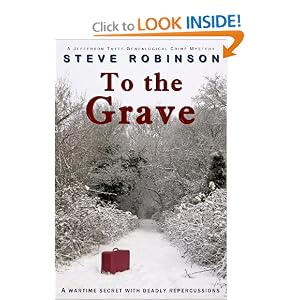
Having now read two of his bestselling books, I'm very pleased to welcome the Genealogical Detective, Steve Robinson, to my blog. Whether he thinks he's a genealogical detective or not, is one of the questions I put to him...
About Steve Robinson
Steve
Robinson was born in coastal Kent, UK, and now lives near London on the
Essex/Hertfordshire border. His passion for writing began at the age of sixteen
when he was first published in a computer adventure magazine and he has been
writing by way of a creative hobby ever since.
When a career in telecommunications ended in redundancy he began to
write full time. His debut novel In the Blood was the result, with To the Grave following a year later.
Steve says
I write for the crime, mystery and thriller
genres with a family history angle, having become interested in genealogy as a
means to tell the story of 'In the Blood' and perhaps because at the time I had
no idea who my maternal grandfather was, which is something that has always
intrigued me. He was an American GI
billeted in England during the Second World War. A few years after the war ended, he went back
to America, leaving a young family behind, and to my knowledge no further contact
was made. I traced him to Los Angeles
through his enlistment record and discovered that he was born in Arkansas, but
until recently that was all I knew.
Perhaps this is why my lead character is an American genealogist.
In August 2012, following correspondence with
an amateur genealogist in Maine, New England, who wrote to me about my books, I
learnt more about my maternal grandfather and my wider American family. I hope to share that story on my websitesomeday.
Steve's latest book - a Jefferson Tate genealogical mystery
The story
HISTORY: from the Greek - historia.
Knowledge acquired by 'investigation'.
It should have been a quiet weekend in London - a
long overdue visit with the only true friend American genealogist Jefferson
Tayte ever had. Now his friend lies bleeding in his arms and Tayte must follow
his research to understand why, making him the target of a ruthless,
politically motivated killer.
Working with historian Professor Jean Summer and
New Scotland Yard on what becomes a matter of British national security, Tayte
soon finds himself in a race to solve a three-hundred-year-old genealogical
puzzle. It takes them all on a deadly, high stakes chase across London as Tayte
tries to connect the pieces and work out the motive behind a series of killings
that spans twenty years.
In what is Tayte's most personal assignment to
date, 'The Last Queen of England' combines historic fact with fiction,
challenging British history as we understand it. It uncovers a conspiracy that
if proved could ultimately threaten an institution that has lasted more than a
thousand years: the British monarchy.
Nullius in Verba: take no one's word for it.
Interview with Steve Robinson
Welcome, Steve! I first heard of your books because my husband had bought and read them all so then I had to read them too. I didn't realise at that stage that I'd be lucky enough to interrogate you on my blog. As far as I know, you invented
the genre of genealogical whodunit, which is pretty impressive these days, when
everything seems to have been done before. Why do you think so many people are
interested in climbing their family tree?
I think it’s part of the human condition to be curious about who we are
and where we came from. Genealogy helps
us to answer that question and with so many records now being digitised and being
made available online, our ancestry has never been more accessible. The exploration of our own family connections
can also breath life into the past as our ancestor’s stories are uncovered, and
then there’s the allure of all those skeletons in the family closet waiting to
be found. I think it’s easy to see the
attraction.
Your main character, the likeably paunchy and flawed Jefferson Tate, fondly
known as JT, is an American genealogical detective and the details of his
work are very precise. Are you a genealogical detective yourself?
Not professionally, although I’ve become something of an amateur
genealogist over the years since I started writing my genealogical crime mystery
series. I have to become one to some
extent when I’m writing or my books would lack credibility. I essentially give myself a problem to solve -
or rather, a brick wall for JT to climb.
At the time I usually have no idea how he’s going to climb it, so I have
to work it out as any genealogist might.
I feel JT’s frustration, too.
There’s a scene in 'To the Grave' when JT is in his hotel room, trying to
find someone, and he literally has no clue as to how he’s going to do
that. The records he needs to see either
don’t exist or are closed to him. So he stays
up all night and grinds it out - and I remember with great clarity doing that
with him. It wasn’t easy and it took me
much longer than it took JT in the book, but we found a way and I think that
also helps to keep it real.
How do you research your books?
Once I have a high-level plot worked out, I carry out similarly
high-level research, just to make sure everything works and is feasible. If I’m writing in a particular time period I
also research that early on. Once I’m
ready to start writing, I research each chapter as I come to it in greater
detail. I never feel that I can do
enough research, but writing with authority in any given subject is as much
about what you leave out as what you put in or your writing can become too
instructional and seem to lack real confidence that only comes from understanding
what you’re writing about. With
historical scenes I feel I have to know enough about the time and place to feel
a part of it. Only then do I feel that I
can write those passages in such a way that the reader will be there with the
characters when they’re reading about them.
Before this interview, I read ‘In the Blood’, so I could read your books
in order, but I really like the look of the second one, based on your own
story. J T says, 'If you can’t find this family, how the hell do you expect to be
good enough to find your own?' Is that personal search part of your own
motivation in writing?
I don’t think it’s why I write, but it’s certainly a part of why I write
about a genealogist who has no idea about his own ancestry. And it’s definitely why I wrote 'To the Grave',
perhaps as a way to fill in some of my own unanswered questions with some facts
and plenty of fiction. I’m honestly not
sure why I feel the need to write, but the need has always been there, as I
suspect it must be with every writer. I
suppose it’s because of those voices in my head that I have no control over -
the dialogue snippets that keep coming to life in my mind that I feel compelled
to write down, but I’ve no idea where
they come from.
As a British writer, how difficult was it to create an American character
and setting?
I wouldn’t say it I found it difficult at all. Whether it’s people or places, it’s all down
to the research and the differences are really very small. There are language differences to understand
and it’s important to get it right. When
JT’s speaking or I show his direct thoughts I endeavour to ensure that what
he’s saying sounds authentic without overdoing it, but other than that, he’s
just a man with a penchant for tan suits and Hershey’s miniatures. I also visit the USA and Canada once every
year or two, which helps, and if you’ll excuse the pun, being a quarter
American on my mother’s side means that it’s in my blood.
Nice pun :) I felt you really knew the Cornwall location in ‘In the Blood’. How
important is setting to you?
I’m a frequent visitor to Cornwall and love it for it’s rugged beauty and
the escapism it offers. It felt easy to
write about the area because I’ve come to know it so well and because it’s such
an evocative place to write about. One
reader paid me a great compliment in a review for 'In the Blood', saying that the
scenery came to feel like another character in the book. Cornwall gets to you like that.
Your route to self-publishing success included 5 years of rejection by
traditional publishers. What are your views on self-publishing versus
old-fashioned publishing?
I’m for any kind of publishing that helps a writer to be read, and since
the advent of the eBook, the opportunities have never been better. I resisted publishing my work independently
for a long time, hoping that the next book and then the next would be the one,
but after getting an agent with 'In the Blood', and after getting so many
promising rejections from the big publishers, I decided that my work deserved a
chance. Above all, I believed that
readers would enjoy it and I’m just so happy that that’s proving to be the
case.
It's good to see you having that success and an inspiration to the rest of us treading the independent road. Which services, if any, do you out-source? Jacket design? Print book
creation? Formatting?
I suppose I’m about as independent as an independent author can be as I do
all those things myself, although I’m fortunate enough to have made a few
friends along the way who proof read my books and find the things I miss prior
to publication, which is as invaluable as it is appreciated.
What tips would you give authors on making a success of self-publishing?
I’m sure there are many, but I’ll highlight a few things that stand out
for me. It’s not always possible to come
up with something new, but looking for a new approach to something that’s
already established is the next best thing.
And be realistic about pricing.
You don’t have much choice when it comes to paperbacks, but for eBooks you
do. It’s a very competitive market and
if no one knows who you are, you can’t really expect them to pay a high price
for your books. Many eBooks are also
free of course and plenty of big-name-author’s eBooks can be bought for under a
pound/dollar. When I started out, I sold
my debut book as cheaply as I could in the hope of growing a readership, so once
someone had found my book, I didn’t want price to be a barrier. Also keep in mind that it’s a long-term
business and it takes some patience to establish yourself. And keep writing. Every book in publication increases the
chance that someone will find you.
There are three JT novels now. Do you have ideas and plans to continue
with the series?
Yes, I’m planning at least three more books in the Jefferson Tayte
Genealogical Crime Mystery series. After
that, who knows? Maybe another series if
the demand is there, and if JT survives of course. I don’t like to know too much about what’s in
store for my characters. I should think
I’ll be plotting like crazy until the summer, and it will be a while before
book four is ready, but I’m hoping there will be less of a gap between that and
the following books as I’ll have already completed much of the plotting and
research for them by then. The next
books in the series will be also more closely linked.
Glad to hear there are more on the way - and I know my husband will be! How long do you take to write a book and what stages does it go through?
The three books I’ve published each took a year to write, but that’s not
really all the time that’s gone into them.
They’ve been through extensive rewrites since I first wrote them, so
that they would better fit into the series that began when I published 'In the
Blood'. Once I’ve worked out the theme
and have the general gist of the story, I’ll do some research and other ideas
often come from that. Then I’ll think
about the ending and start plotting in earnest, working towards that end. This is when I start to weave all the
sub-plots in. I didn’t plot that much
with my first book and I ended up with 165,000 words and a lot of headaches,
backtracking the plot and then cutting content, so I plot more thoroughly now
and try to write a tidy first draft of about 100,000 words or so. I’ll go through four or five drafts before
I’m ready to let anyone else see the book, then my wife reads it. I’ll then do another draft, set a publication
date and send it out to proof readers. I
do a final polishing draft about a week before publication and I publish the
eBook first as it’s easy to make corrections to the digital edition. A month or so later, I set the paperback
edition rolling, then I get cracking on the next book, having had a natural break
from writing while I’ve been publicising the new release.
It's interesting to hear the detail of your re-writing - so few people realise how much work goes into books as good as yours. What would you say is your most interesting writing quirk?
I’m sure it’s not particularly interesting, but perhaps it’s quite quirky
that I wear an old olive-green bucket hat when I’m writing. I started wearing it to keep the sun out of
my eyes when writing in my kitchen, and then I found that it also helped to
focus my attention on the words in front of me as it cuts out my peripheral
vision. In his book, On Writing, Stephen
King suggests that you put your desk in a corner of the room, away from the
windows. I suppose my bucket hat has
become my way to eliminate undesirable distractions wherever I’m working.
You should have an author photo with the hat! Like Terry Pratchett. What was one of the most surprising things you learned when creating your
books?
That would have to be when I learned the whereabouts of my American GI
grandfather. I now know that he was
buried in a military cemetery in Los Angeles in 1990. I didn’t expect to discover that through my
writing. It came about following an
email from another writer and amateur genealogist in Maine who initially wrote
to me to say that she’d enjoyed reading 'In the Blood'.
Do you hear from your readers much? What do they say?
I get emails most days and feel both flattered and humbled to think that
someone has taken the time to write to me. I love receiving them and they’re typically
written to express thanks for the enjoyment my books have given, which is
wonderful. Some readers also share a
little of their own family history or talk about one or more of my books in
greater detail. I always reply and I’m
surprised at how unexpected that can be.
It seems the least a writer can do in return for the kind words and
support, and I hope to be able to continue writing back no matter how many
emails I receive.
I noticed that you make your contact details readily available in your books and I've started doing the same, following your lead.
I believe that you’re a keen photographer. What gear do you have? What do
you enjoy about photography?
I’m just getting back into SLR photography after a break of about twenty
years, and as I create my own book covers I thought it was about time I got
some decent equipment. I’ve used Canon
digital compacts for years so I stuck with Canon for the DSLR. On one level I enjoy the creativity, and on
another I like seeing the detail in the world around me that I can’t easily see
with my own eyes - such as with macro photography and photos of wildlife. I also enjoy the challenge of getting close
to wildlife to get the shot.
What else do you like doing in your spare time?
You’d think a full time, independent author would have plenty of spare
time to play with, but I don’t seem to find much lately - or don’t allow myself
much between the writing and the marketing and keeping the house and garden
tidy. Not that I’m complaining about
anything - I’m really enjoying it - but publishing is a business like any other
and you have to put the hours in if you want it to be a success. When I do switch off, I have a guitar that I
started to learn - and now need to pick up more. I like to play golf and there’s the
photography of course, which I’m also hoping will encourage me to take more
regular walks. Spare time activities
seem to vary, depending on what part of the writing process I’m at. When I’m plotting for instance, I often find
that I need to just walk away and do something else, particularly if I’m trying
to solve a major plot issue - the answers to which invariable come when I’m not
actively looking for them.
Thank you, Steve, and what are you doing chatting to me? Get back to writing the next JT novel! Your fans are waiting. My reviews of Steve's first two books will be in my next blog post.
Keep up to date with Steve Robinson's news and read his other interviews on
his website
Next Blog my reviews of