Tuesday, November 27, 2012

Win a rip-roaring 17thC adventure book


Knox Robinson Publishing
see amazon uk page here

WIN A SIGNED HARDCOVER COPY OF

THE CHOSEN MAN

ISBN 978 1 908483 24 9

To celebrate the release of the paperback edition of The Chosen Man on the 6th December, 2012, J.G. Harlond is running a promotional competition on her website.
Click on: www.jgharlond.name

Go to 'Competition' on the home page.

Click on 'Read'.

Read the chapter then answer the questions that follow.

Email answers to: jgharlond@telefonica.net

Deadline for receiving answers: 20th December, 2012
The lucky winner will be selected from those submitting the correct answers on 24th December, 2012.
J.G. Harlond will contact the winner for his/her home address via email.

J.G. Harlond - about the author


THE CHOSEN MAN

J.G. Harlond

It is 1635, Ludovico da Portovenere, a charismatic spice and silk merchant, is on a routine voyage from Constantinople to Amsterdam, but his voyage is interrupted; first by a timid English priest with a message from Rome then by a storm, and then by a pirate raid. Ludo’s plans are disrupted, as are the lives of the innocent people unwittingly entangled in his secret commission.


MY Review of 'The Chosen Man'


fun and full of energy; an entertaining read

Imagine Jack Sparrow working for the Vatican to break the Dutch economy by boom-and-bust selling of tulips; and a 17th century Spanish Lara Croft sorting out an English stately home with incidental husband and resident villain. This novel is fun and full of energy; black comedy abounds. The wide-ranging historical background is also very intelligent and well-informed, while in no way slowing down the swashbuckling story.


The slow-burning romance between the two lively main characters, Ludo the loveable rogue, and Alina, the feisty Spanish girl stranded in a foreign country, adds to the enjoyment. However, the two plots are otherwise very separate and this makes for some disjointed storytelling, with awkward jumps in viewpoint.


I've read 'Tulip Fever' so knew some of the historical background, and was expecting this to be heavy,depressing and political, especially in our time of 'financial crisis'. Not a bit of it! I found `The Chosen Man' to be a very entertaining read and I would definitely read another novel by this author.

Friday, November 16, 2012

Win a 19th century murder mystery

amazon uk link


WIN A SIGNED COPY OF 


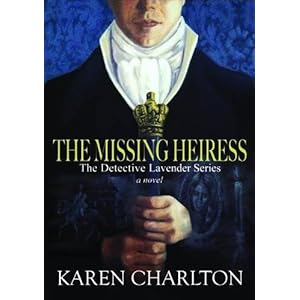
THE MISSING HEIRESS


To celebrate the launch of her latest novel, Karen Charlton is running a fantastic promotional competition on her website.

Simply read the extract of Heiress posted on the books page of her website:

Follow this link to the extract

Then, using the form provided, answer the question:
'What is the name of the thief arrested by Constable Woods at the Whitechapel Toll Gate?'
And you could be the lucky winner of a signed copy of her latest novel!

But hurry! The competition closes on December 31st.

The winner will be announced in January.
Full details available on her website homepage:

Book description


Northumberland, November 1809. A menacing figure stalks women through Hareshaw Woods and when Helen Carnaby, a beautiful young heiress, disappears from her locked bedchamber everyone fears the worst. The townsfolk cry 'witchcraft' and the local constabulary are baffled. Helen Carnaby's worried uncle sends for help from Bow Street magistrates' court in London. 

Detective Stephen Lavender and Constable Woods now face their toughest and most dangerous assignment. Convinced at first that this is just a simple case of a young woman eloping with a lover, Lavender and Woods are alarmed to discover a sinister, murderous world of madness, violence and secrets lurking behind the heavy oak door of the ancient pele tower at Linn Hagh. Why did Helen Carnaby flee on that wintry October night? How did she get out of her locked bed chamber? And where is she now? 

Hindered by Helen's uncooperative siblings, distracted by gypsies, rebellious farmers, highwaymen and an attractive and feisty Spanish senora, Helen Carnaby's disappearance is to prove one of the most perplexing mysteries of Lavender's career. Set in the beautiful market town of Bellingham, 'The Missing Heiress' is the first in a series of Regency whodunits featuring Detective Lavender and Constable Woods.

Tuesday, November 6, 2012

So you think you've finished writing your novel?

I selected this post to be featured on my blog’s page at Book Blogs.


I can't believe it's two months since I last blogged but in that time I've written 40,000 words and finished the new novel, the follow-up to 'Song at Dawn', so turning into a recluse has all been worth it.

How do you feel when you finish your novel? I am always elated, ready to celebrate with a very good bottle of wine, convinced that this is the most wonderful book ever written. I need a print-out straight away so I can see the sheer number of pages, feel the weight of paper covered with my words. After ten months' work, I have finished my latest masterpiece.

A week later, I am suicidal. My masterpiece is rubbish. Why would anyone ever want to read such trash? I should burn it and forget writing. I should take up crochet instead.

Another week later, with some helpful input from the man who always reads my work first and yet has stayed married to me, I realise that my novel needs some work. After I've put in the work, and only then, I think it will be well worth sending out into the world, for my readers to judge its quality. By the time my readers see it, this novel will be as good as I can make it, and I will be proud of it.

This is my fifteenth published book and I go through the same emotions every time, which apparently is a little wearing to live with, but it is just part of the process for me, and it's easier to accept it when you've been through it before.

It seems to me a great pity that more and more writers are publishing at stage one, elated at finishing, impatient to get their books out there, to get the adrenalin rush of seeing their precious work in bookshops, on amazon, on smashwords, on real people's virtual and physical bookshelves. Believe me, I understand the temptation and the impatience. After all, you've followed 50 shades of marketing and done every single pre-publishing platforming networking activity known online - right? 

But your book is not yet good enough to publish.

This is important enough to repeat. No-one's book is good enough to publish the moment s/he puts the last full stop in place. However experienced a writer is, however many million books s/he has sold, this is always true. You haven't 'finished' your book when you write the last sentence. You've written the first draft. 

You think this applies only to self-published authors and the publisher will do the rest of the work? Wrong. Publishers put huge pressure on their writers to meet ever-tighter deadlines, at the same time as expecting ready-to-go typescripts. The days when editors worked with writers on the content of their novels are long gone and high-quality editors are few and far between. When an author sends his/her 'finished' work to the publisher, editing can vary from a proofread to, rarely, 'old-fashioned' discussion about improving the book. Mostly, I see the book going to print pretty much as it left the author, who usually submitted it to the publisher sooner than s/he would have liked, without any revision time.

Advice on 'keeping readers happy' is making this fast-food mentality worse. We are told to keep in the public eye by producing books regularly and 'shorts' in between. No wonder there are so many badly written, badly edited books around, both self-published and from reputable presses. Pressure!

Just suppose you resist the pressure and want to make your book better before it goes out to your readers. What should you do? It depends on what sort of book you're writing but this is what I'm doing:-

the Editor

The Editing Process


1. Read the whole book in one go, noting any technical errors, any inconsistencies, any continuity problems, any lapses in point of view, and any weaknesses in plot or dialogue. I always print out my novel, double-spaced, and sit down in a comfy chair with a red pen, to mark up the typescript. I don't care how teacherly red pen is - it shows up well! I have my own shorthand for picking up on errors but if you want to use professional editing symbols, they can be found online. I thought this was a good list of editing symbols.

When my books have been conventionally published, I've accepted or rejected publishers' editing by both response on printed galleys and on Word in editing mode. If I'm editing/feeding back on someone else's work, I use the editing options in Word.

Technical errors - grammar, spelling, punctuation, formatting, font

Consistency - names (a big problem for me because 12th century spelling was erratic and I'm using four languages - English, French, Occitan and Arabic. The same historical character has a different name in different languages)
                   - choices on e.g. use of hyphens in words, so that the same choice is made throughout the novel (for instance, I decided on bedroll rather than bed-roll)

Continuity problems - e.g. the knight was holding a dagger but he kills the enemy with a sword. It's very easy when writing over a period of ten months to make these sort of mistakes. Time often trips you up - you said it was night and yet here they are in broad daylight; you said your heroine was pregnant by the hero but they only met two months ago and the baby's arrived! 

Point of View - check for switches of viewpoint too close together. 'Head-hopping' is a classic beginner's mistake - choose one viewpoint and stick with it for a while, regardless of whether it's 3rd person or 1st person. Check that the viewpoint works, both in showing that character and in showing only what he/she could know or see/hear. If you're using an omniscient narrator, check that the voice is consistent.

Weaknesses in plot - Does everything fit with what has been written earlier, about events and about characters? Are the characters behaving in character? Think about the action from each person's viewpoint. Have you sacrificed believability for action? Are there big gaps, which need some explanation? Are there parts which are confusing? (In my novel, 12th century politics in the Holy Land is part of the plot and I have to remember that my readers haven't spent a year researching the period - I have to cut out the stories that are fascinating but off at a tangent, the historical detail that isn't needed for this story, and I have to make it clear in a couple of sentences who these historical characters are)

Weaknesses in dialogue - Does it fit the characters and period ( in a historical novel, anachronisms are real clangers and most likely to appear in speech)? Real dialogue is oblique - people don't follow on exactly from what is said before.
 e.g. 'That's the phone.'
'I'm in the bath'
This exchange is not logical but makes perfect sense. Check that dialogue is lively and realistic, without dropping into the boring ums and errs and trivia of real speech. Unless, of course, that's your aim.  

2. Re-write - cuts are as important as changes and additions.

3. Input from others - make critical friends. Writers' groups in the real world and online are a great source of support and critical input. You very soon figure out which people are the right ones to help you with which book, and of course you help them in return (or you pay them, or both). I now have a truly wonderful network of writer-friends and the historical novelists in my network are going to read and feed back on 'Bladesong'. I trust them to find any horrible anachronisms, dialogue or big faults in plot or structure. They might find all kinds of other faults too but I know their feedback will be constructive so that will lead me to

4. Re-write - using the input from other people.

5. Copy edit - the fine toothcomb stuff. Zap every mistake in grammar, spelling, punctuation, formatting and technical consistency. Sod's law means that you will have introduced new mistakes with your re-writing.

You think you can do the final edit yourself? Have you ever shown a page of your work to a really good professional editor? Did it pass the test? I'm an English specialist, who used to teach English, and I'm a reasonable editor, but I miss mistakes in my own work. This time, I'm getting it checked by a professional. As I already have three excellent, pro editors in my network of writer-friends, I don't have to trawl through lists of strangers and take a gamble. If you are looking for an editor, talk to other writers to find one they'd recommend. Genre forums are very useful because people writing the same sort of books are sharing their experiences. 

I tried an editing task in the writers' group I run monthly. I'd doctored a piece of writing with a variety of different mistakes and my writers all had time to edit the piece. Then I read the piece aloud and they stopped me any time one of them wanted to make a change. As well as raising issues of subjectivity and ownership (the 'editors' became very possessive of their changes and preferred their version to the writer's), the exercise came up with one unexpected outcome. Not one of the editors picked up on the doubling up of words 'was was' until the piece was read aloud and then they all kicked themselves for missing this mistake - twice.

It is very difficult NOT to read for sense and miss such mistakes - which is why you need a good editor.

6. Finished! Ready to publish.

'Bladesong' will be published early in 2013 and I hope that if you read it, you won't be interrupted by mistakes on every page. I'm sure there will be some mistakes, as the proof-gremlins always create a few. These tiny creatures visit edited works and add errors, for the sheer pleasure of seeing the writer's and editor's faces, when they say, 'I know that was correct when I sent it off!' Every author and publisher I know has confirmed the existence of the proof-gremlins, so it must be true.




Sunday, August 19, 2012

Prize-winner in Global Ebooks Award

I selected this post to be featured on my blog’s page at Book Blogs.


Some time between 3am and 6am my time, far far away in Santa Barbara USA, at a Gala Awards Celebration, someone announced that 'Song at Dawn' had won the Dan Poynter Global Ebooks Award for Historical Literature Fiction (medieval) category. I'll certainly take a look at the other winners to choose books to read myself, as I judged another category and was very impressed by some of them.

Of course I wasn't physically there. Some of you will remember my previous misses at attending Awards Ceremonies. At least this time I knew it was too far away, too expensive a trip, and too costly in family time to even think about going. My writer friends tell me how wonderful - and useful - it is to attend such events. If I were rich and alone, maybe I would swan round international literary events, dispensing wisdom. And hitching up my new dress which would forever be slipping, wiping my runny mascara (from all those tearful acceptance speeches) and feeling vaguely out of place and foolish. Waiting for the wisdom to arrive so I could dispense it. Maybe I'm just not an Award Ceremony person.

Instead, I'll probably watch the slideshow of the Global Ebooks Awards, when it comes online, and imagine how I'd have swept up to the stage looking all glamorous. I can always sit and gloat over my  'winner' sticker. It's cute but the jacket really wasn't designed to take a sticker. Do big publishers always leave space in the cover design for the prizes? For the killer review quotes? Every time I see white space on a jacket now, I think 'Hah! S/he didn't win anything, did s/he!'

I didn't make it to the USA but the Internet is a wonderful thing and the USA is coming to me, in the form of author and Editor J.T. Hinds. Yes, the Impeccable Editor herself is visiting me, my writing group and my little French village. It won't be a big event but we've planned a joint workshop to give feedback on work to local people of all nationalities who write in English. There won't be many there but already I'm getting such enthusiasm about the event. 'The Impeccable Editor's Guide to Writing' is en route to publication and I'll let you know when it comes out. You can get a preview, with free advice from a professional writing coach and editor, here

Otherwise, the heat here is brain-frying and I'm cutting myself some slack from writing and photography to cater for summer visitors and chill out with the dog. With regard to the new novel, I'm starting to sound like Bon Jovi 'Half-way there and living on a prayer' but the more I hear from readers that they love 'Song at Dawn', the more determined I am to get on with 'Bladesong', the follow-up.

Thursday, July 26, 2012

Flag-waving


UK Supporters in hot tub


I've been home and busy for three weeks after a fantastic shoot with nine other photographers and nine models, in a luxury house we rented in Yorkshire. One of the scenarios we shot for stock use was flag-waving by supporters - on the couch, in the hot-tub, in the field. Only now, when I'm looking over my final versions of shots, with the Olympic Games Opening Ceremony due to start, am I really taking in how much people enjoy waving those flags.

National pride is double-edged and every group creates exclusion. Maybe, because of my migrant background, I'm too aware of this and of the historical abuse of national symbols, and maybe I should look more at my own photos. People like waving flags, they like supporting their team and it's all fun.
French supporters

Of course, the fun turns sour quickly if you're on the women's football team of the Democratic People's Republic of Korea and they've introduced your team with a video on the big screen showing the flag of the Republic of Korea. North/South/Democratic or not - easy mistake? Not if it's your flag and your team. Imagine you're playing for Wales in the USA and up goes the St George Cross. My American readers have no idea the outrage that would be felt. You have to be inside the group to feel it. And there's no doubt the Koreans felt it! No way were they playing with that flag on the screen above them.The first cock-up of the 2012 Olympics (as far as I know) is over waving the wrong flag.

Scotland the Brave


There will be more and bigger cock-ups as the adrenalin flows and the cultures clash. But there will also be those stories of personal triumph and tragedy that touch the soft spot in us all. I was moved by the successes of 'British boys' in the Tour de France but interested in Wiggins' forthright response to (French) interviewer that he had done it for himself, not for Britain. I am currently being congratulated by everyone from the doctor to the cheesemonger in my small French village for 'my' success in the Tour de France and although I'm happy to take the credit and bask in the glow, that means I'll also take the blame if a British athlete is a 'bad sport' (especially in any activity involving a French person). I hope that the French insistence on how 'English' fair play is, will be born out by events.

I suspect I will be spitting at every mention of the word 'English' by the end of a hundred French commentaries on UK competitors,  as will every good Welshperson - or Irishperson or Scot.
Wales supporters

I won't be waving any national flags but I do support Wales, Scotland, UK, France, England as teams - in that order. My own brand of flag-waving is reserved for the personal successes and moments of cameraderie and support, both between team-mates and across barriers. I know someone who has reached the team for the opening ceremony, after a tense time as reserve,  and I know that just being there is a special moment for him. I'm waving my flag for him, and the others in that Opening Ceremony, who had to apply for the privilege and are all good at something in the sports world. I'm waving my flag for that friend.

 What I love best in competitions are the friendships and support that happens. Which brings me back to the shoot I mentioned at the start. Ten photographers, who will all be competing to sell our photos, and who all helped each other to achieve results none of us would have got alone. Now I'm really waving my flag. Let the Games begin. Or rather the J.O. as we call them here in France, making them sound like a sexy film star.

Parents asleep while supporter cheers

Tuesday, June 19, 2012

Alice and anorexia - interview with author Fiona McClean

amazon link


Alice loves to paint pictures of fish. Her only problem is her addiction to cakes and pastries. To feed this obsession, she steals ...and to rid herself of her spoils, she makes herself sick. Stick thin, Alice puts her fragile mind into the care of a psychiatrist, Professor Lucas, and tries to learn the rules people should live by. But her recovery soon brings a new and dangerous addiction - Brendan. As Alice struggles to cope with Brendan's violent outbursts, her dying father and poverty, she takes solace in her job at a massage parlour where she finds comfort with motherly Helen. But these are just temporary respites as her life with Brendan spirals downwards becoming a nightmarish maze.


When I first met Fiona McClean I didn't know that three years later her debut novel would win the rare double of  praise from literary critics and  from readers who relate to the anorexic character, Alice - but I am not surprised. Fiona turned up at the writing group I supposedly run, in this small French village, and told me she was following a distance course in Creative Writing but wanted to learn from our group too. I was daunted at the prospect of being challenged over everything I said that clashed with the university certificated voice of authority but I needn't have worried. There are indeed clashes of opinion within our group but it is typical of Fiona that she enjoys diversity and certainly never claims the voice of authority to be on her side. She writes instinctively and originally but wants to learn all of the craft that she can, to improve her writing. From my point of view, it's like teaching anatomical drawing to Van Gogh.

Fiona McClean - photo Jean Gill

I have this fantasy that in the future, some biographer will look back on the mix of writers and artists who form our group, and marvel that such a small French village fomented all this creativity. Our tiny bookshop venue will be as famous as the Left Bank Parisian cafe where Sartre and de Beauvoir argued. If it is, it will be thanks to the work of Fiona McClean, although I know she'd rush to contradict me and point out the others' talents.

It was fitting that the launch of Fiona's novel 'Under the Bed' was in that same bookshop, so crowded that people spilled onto the street outside to hear Fiona read extracts and answer questions, with Lesley, a friend from the group.

Book launch - photo Jean Gill

Bonjour Fiona,
Your first novel is now out in paperback and had a rave review from 'The Bookseller' so it seems a good time for me to interview you for my Blog. Although 'From Under the Bed' is fiction, you've been open that it draws on your own experience. What was it like for you to write about those experiences, some of them very painful?

My experience of Anorexia Nervosa and Bulimia happened a long time ago. I was curious to rediscover that difficult period and see it in hindsight, with a new perspective. I don't remember writing about it being traumatic, but yes I did feel tired sometimes and I left long gaps between writing each chapter. It was not so traumatic for me perhaps as the book is partly autobiographical and partly fiction. I saw my role in writing it as a storyteller.

Alice intrigues me as a character because, as I see her, she is so fragile and yet she doesn't want to be rescued. How do you see Alice?

Alice doesn't want to be rescued because her illness is her identity and she is afraid to lose that. Without it she may feel empty and lonely. Alice at the beginning is not mature enough to cope with responsibility and her illness provides an escape from that. Like many illnesses bulimia and anorexia are addictive, leaving the person helpless and if without resources, unable to give up the addiction.

Like Alice, you are a talented painter. How did you discover you could paint? How did you career as an artist progress? How does your visual art combine now with your writing?

I discovered painting at school and was encouraged to paint by my parents. Since school my dream has been to be a painter. I had an experimental period at art college when I specialised in performance for my degree, but afterwards I continued to paint. After several years I was taken on by The Merriscourt Gallery and the New Grafton Gallery, both of whom encouraged and supported me. Recently I have concentrated on drawing a series of sketches based on life at the hairdressers. I hope to do some paintings based on the drawings.

My writing is visual, using metaphors and descriptions directly as an influence from painting. My paintings are partly inspired by colours and the work of the Fauvists

What do you hope readers will take away from reading your novel?

I hope people who have read 'From Under the Bed' will be aware of how fragile life can be.

When you've given readings, what questions arise? What are your answers?

During readings people often ask if its autobiographical.
It is so far as I had the illness anorexia nervosa and bulimia. Some of it is fiction, though I often don’t know where to draw the line between them both. Alice is not me nor does she completely represent my experience of anorexia, but yes there are many parallels, her love of painting being the main one. 

Why are the characters in the book written without depth?
Alice didn't relate to people in much depth showing that she was not yet capable of mature relationships. Her relationship with her parents was detached as she was unable to connect with any real feelings for them. She was a person obsessed by her illness and art.

What is the reason for the anorexia in Alices life?
There are many possible reasons for anorexia including, chemical imbalance, problems in the family, fashion related, work related- if you are a model for instance or a ballet dancer you are already on a severe regime which may tip the balance. Alice was obviously affected by what is fashionable. I did not want to specify any particular reason and especially did not want to point a finger at the family.

In these changing times, how did you find a publisher?

I put my book up on an online creative writing group created by Harper and Collins. It was read by the publisher Roman Books who after seeing the manuscript accepted it for publication.

You belong to a local writers' group. Would you recommend other writers to join one? What are the advantages and disadvantages of online writers' groups versus those which meet up in the real world?

The writers' group is a life line and the once-monthly meetings the highlight of the month. You don't get tea and biscuits and the chance to chat live in an online group but you do get many more readers reading and reviewing your work. In my local writing group I find it is more likely I will continue to attend; with an online group I am less motivated. There is something to be said for seeing people rather than reading about them.

What are your writing habits?


I often write in a friend's house as at home I am distracted. To limit distractions when I do write at home I write in the night or in bed even. Cafés are a good place to write too. I often stop writing for the day, at a place in the story unresolved so that I have something to work on the next day.

What are your other top tips for other writers?

Read books on how to write a novel, this helped me a great deal, especially one book called 'Stein On Writing'. Go for walks whatever you need to recharge your batteries. You need breaks. I allow people to read my novel as I write because to some extent I lack confidence and need good criticism and encouragement. Be careful who you show it to! And definitely join a writers group.


What have been your best moments as a writer? Why do you do it?


In the night, after a glass of wine – just one or two though! Helps the writing flow and of course giving talks, nerve wrecking but they are rewarding. I feel good though after finishing a chapter I am pleased with. The best moments are when someone contacts me to say they like the book and even better if they say why.

I am three-quarters of the way on my second book called 'The Cappuccino Kiss'.  It is about Juliet, a woman afraid of dust. I am working on it every day and hope to finish by September. I have heard the second book is the hardest and certainly I am finding it a challenge.

Thanks for dropping in, Fiona, and for the scoop on the new book. Good luck with 'From Under the Bed' and with the next novel. See you at the Writing Group.


 My review of 'From under the Bed'

Surprisingly enjoyable, given the themes of anorexia and domestic abuse. The central character, Alice, might be naive, and at times there is the urge to 'sort her out', but the reader learns to appreciate Alice as she is and question the society that wants to change her. It is a pleasure to see life through Alice's eyes. The style is very much that of an artist, finding exactly the right image to bring a character, a place or a detail alive for us. Highly recommended - a book that you won't forget. 


Wednesday, June 13, 2012

Depression and a baby deer

I let myself get bogged down in judging books for a competition, in support and feedback to other writers, in thousands of photographs both for a client and for me, after an amazing but hectic trip to Venice, and of course in a million tedious domestic chores that I'd been putting off. I felt I was scrambling to meet self-imposed deadlines and forever chasing unkept promises, keeping no-one happy, least of all me. I was starting to feel guilty before I checked my mail, knowing that there would be a reminder for something to do. It was too long since I'd spent time in the 12th century and I saw little chance of getting back there. In those trivial ways that matter to a novelist, life was getting me down.


Then my husband yelled for me to look out the window. He'd just seen a mother and bambi sauntering down the drive and I caught them bounding into the field opposite. The mother came back to collect her little one who'd lost her in the long grass, poppies and wildflowers. Then off they sprang, the baby's ears appearing and disappearing in the greenery. Peace returned. Looking at two pairs of ears is more important that the things I don't get done. 


To add to my newly-recovered zen state, I've had several messages all at once, suggesting that my time wasn't wasted, so I can combine feeling virtuous with returning to the 12th century.

Congratulations to the winner of nine signed first editions from different authors names from all over the world went into the draw and the lucky reader lives in Spain.. Books are heading your way from all the authors.


If you want to help me choose my 'look', pop along to Kristin Gleeson's website where you'll see 3 author photos - I can't choose between them. A strange fact is that amazon.fr  doesn't allow author photos with pets. Other amazons have no such prejudice. 


This made me wonder about cultural differences, to which I am more sensitive than usual after being asked for passages from my books 'suitable for a GCSE English comprehension in a textbook for 2nd language English learners in other countries.' Further detail required that the passages 'be demanding but have 'no politics, no sex, no religion, and definitely no pigs in their content'. Searching 14 books with these criteria in mind, you'd be surprised how full my books are of politics, sex, religion and  pigs. I hadn't realised how controversial my work is, and I feel very proud.


After one dead end - dogs would be considered dirty in some of the cultures using the textbook - I did find something suitable but the whole exercise left me bemused. I'm not sure what my cultural background is but I know it 'allows' me to read work written in cultures which impose all kinds of behaviour and topics that I find unacceptable. Two questions come to mind; if you are studying a language but everything in that language which doesn't fit with your culture is censored, are you really studying the language; and, should tolerance accept intolerance? The old paradox. My answer is always that you reach people in closed cultures by reaching them at all. If that means not mentioning pigs, or dogs, so be it. It doesn't mean I like it though.


I'm nearly half-way through the year and 43,000 words through my follow-up to 'Song at Dawn', which has kept its working title of 'Bladesong', announced for the first time in my recent interview for Kristin. She asked some hard questions!

Extract from the interview. Read the full interview here
K- One interesting aspect of the novel is Dragonetz’s paper manufacture and the vatican’s determination to prevent it.
Is this based on fact?

J- You've reminded me! Yes! Completely! This was one of the
facts that really fixed the choice of period for me. I am still absolutely incensed at the various ways the Roman Catholic Church destroyed scientific, medical and engineering progress for centuries. There really were paper-mills created by Christian Europeans, who learned the skills from their Arab neighbours in Al-Andalus (modern Spain) but 'the work of the devil' was successfully eradicated from Christian countries. Needless to say, the Church preserved a profitable monopoly on reading and writing this way.

I was a teacher for many years and someone who inspired me was the great Brazilian educationalist Paolo Freire. I attended a talk he gave at York University, where I was a trainee teacher. He was exiled for teaching peasants to read and write, and I never forgot what he taught me - that literacy is power. Making paper was a revolutionary step, which is why the Vatican stopped it as long as possible.

Exploring the twelfth century led me to understand how highly developed some civilisations were, and the ways in which individuals shared this knowledge even when institutions were out to prevent them.


To return to where the Blog started, with my mind elsewhere:-
Venice was amazing. Worse and better than I'd remembered. A hundred thousand people invading St Mark's daily at 9am and returning to their waterbuses at 5pm, having seen  only the 2hour queues for the Basilica and the Doge's palace. Those lucky enough to time their trip for a day of torrential rain saw even less, with the additional pleasure of likely death by umbrella spoke on overcrowded waterbuses.

However, there was also the 5am shoot in breathtaking dawn solitude, the unexpected glitz of the Americas Cup and the Sensa Festival (where the Doge symbolically married the sea in olden times), lunch with a dear Austrian fiend also in Venice, and the personal demonstration by a master glassmaker on Murano, as we were the only tourists who visited that particular atelier. He said my photos were 'bellissima'. I was happy.

I didn't take these photos. Venice made them.

Bridge of Sighs


Romance in Venice


More of my Venice photos